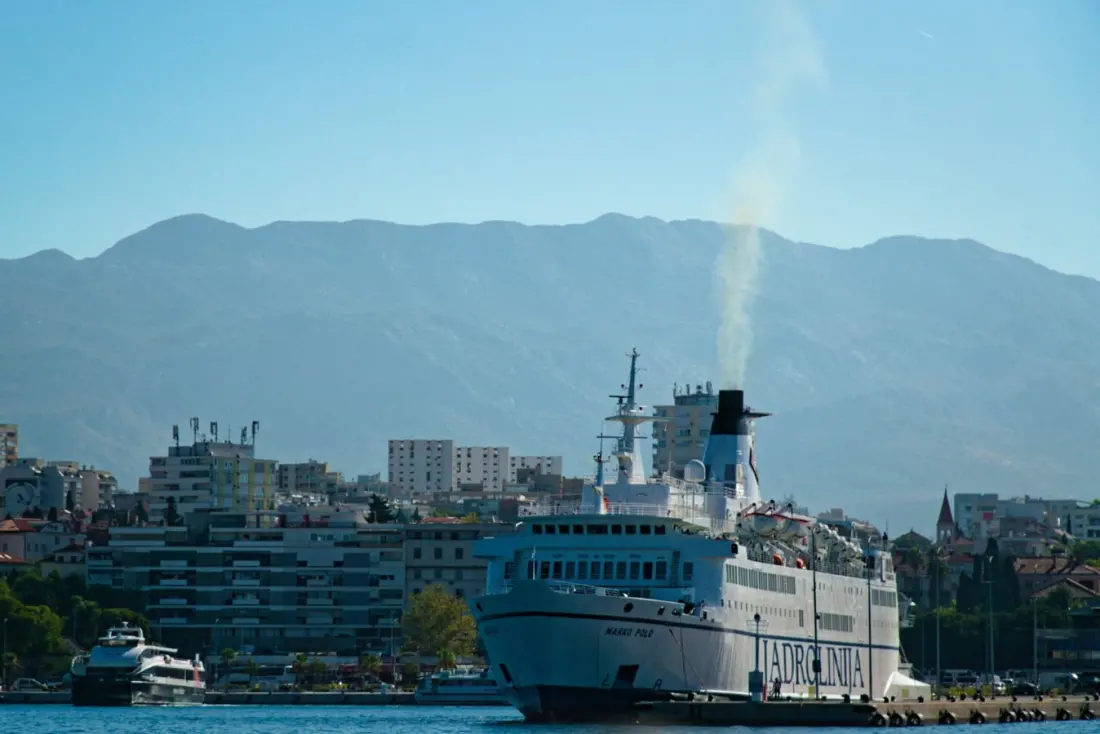
Split's harbour has quietly levelled up. The Adriatic city's port has opened a new international passenger terminal, wrapping up a project worth more than 20 million euros and largely funded by EU money through Croatia's National Recovery and Resilience Plan.
The numbers behind it tell the story: passenger traffic at the city port has grown nearly fourfold and vehicle traffic threefold over the past 25 years, and the old, run-down terminal simply couldn't keep pace. The replacement covers more than 12,000 square metres in total, with a building of nearly 3,000 square metres. Arriving passengers are handled on the ground floor, while the upper level groups the practical stuff — police, customs, security and the port authority — under one roof.
There's a logic to how traffic is now organised. International sailings have moved to the port breakwater, where the new terminal sits, while the St. Duje Quay — over 10,000 square metres with six berths — has been given over entirely to domestic ferries. That's good news for island-hoppers: locals and domestic travellers now disembark closer to the city centre, and the old terminal building has been repurposed for domestic traffic too. Anyone planning a ferry trip to Hvar, Brač, Vis or the further-flung islands should find the whole experience less chaotic than in years past.
One detail worth getting excited about: port authority director Vice Mihanović has announced the terminal's roof will be opened to the public, with a children's playroom, an outdoor gym and a telescope planned for the space — an unusual amenity for a ferry terminal, and one that should double as a decent viewpoint over the harbour.
More is coming. The port authority has lined up four further projects worth close to 60 million euros, including an expansion of St. Peter's Quay by more than 5,000 square metres and two additional berths. Split's mayor, Tomislav Šuta, has also flagged plans for a landscaped lungomare and a viewpoint in the area, which would tie the port more neatly into the city's waterfront.
For travellers, the practical upshot is straightforward. Split is the main jumping-off point for Croatia's Dalmatian islands and a hub for international ferries to Italy, so smoother customs and police processing, clearer separation of domestic and international sailings, and a less shabby arrival experience all add up to easier onward travel. If you're flying into Split Airport and heading straight for a ferry, the improved layout should cut some of the friction out of a same-day connection — and once the rooftop opens, you might even want to arrive early.