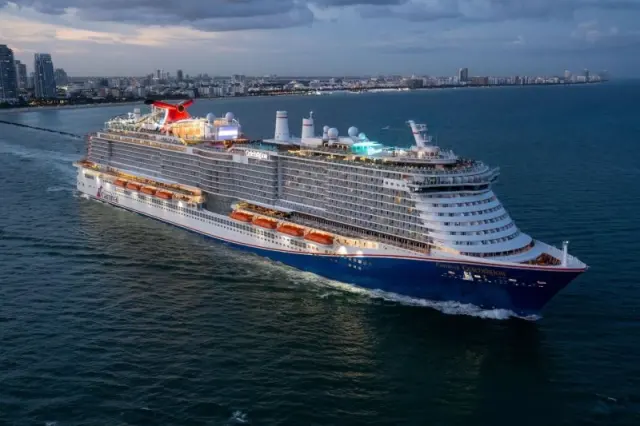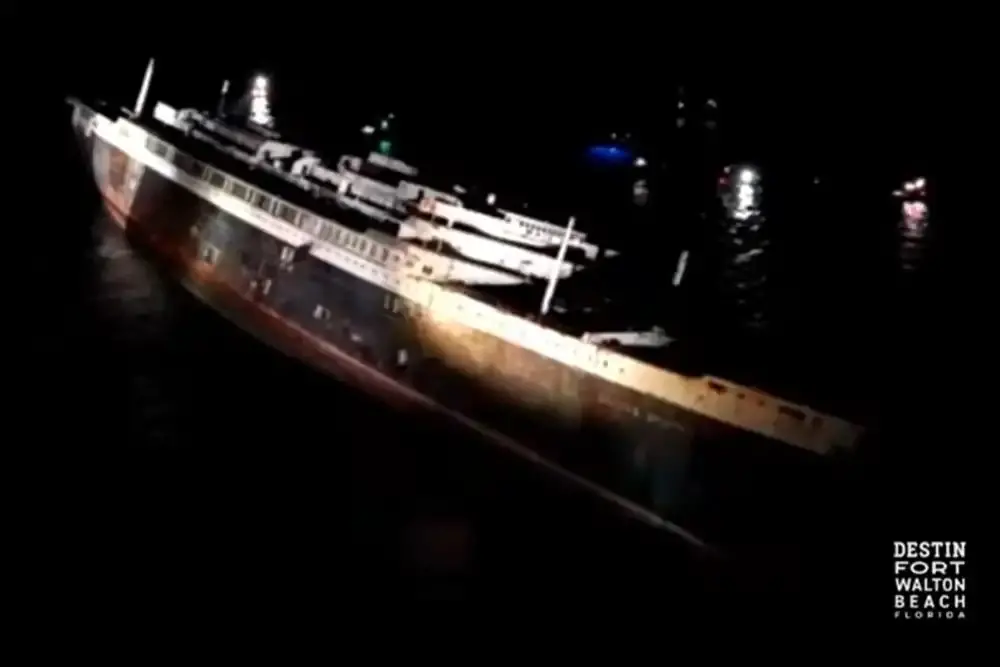
The fastest ocean liner ever to cross the Atlantic has gone to a new job: sitting on the seabed of the Gulf of Mexico. The SS United States, a 990ft (302m) behemoth that held the Blue Riband for the fastest transatlantic crossing, was sunk on 12 November around 22 nautical miles off Destin, Florida — and now holds the record as the world's largest artificial reef.
She beat the previous title-holder by a wide margin: the aircraft carrier USS Oriskany, scuttled near Pensacola in 2006, measures 888ft. The United States is roughly 100ft longer and now rests only about 14 miles from her predecessor, making this stretch of the Florida Panhandle arguably the best big-wreck diving region in the world.
The road to the seabed was long and, at the end, slightly chaotic. Launched in 1951, the ship set a maiden-voyage crossing record of 3 days, 10 hours and 40 minutes in July 1952, shaving more than 10 hours off RMS Queen Mary's 1938 time, and carried 1950s stars like Marilyn Monroe and Cary Grant. Jet travel then killed the liner trade; she spent decades laid up, first in Norfolk, Virginia, then nearly 30 years mothballed in Philadelphia before being ordered out in 2024. Okaloosa County bought her for $1 million, had her stripped and cleaned in Mobile, Alabama, and towed her to the site — only for the SS United States Preservation Foundation to mount a last-minute legal challenge over possible contaminants. The sinking survived that, then was pulled forward a day to dodge bad weather.
With explosives off the table, crews flooded her through her own pipework and drilled holes in the hull. The ship built to be unsinkable proved stubbornly good at it, taking hours longer than planned before finally going down around 9pm under darkness, listing heavily to port. Whether she landed upright remains unconfirmed.
If she did settle as planned, the site is remarkably diver-friendly: the seabed at around 55m (180ft) with upper decks at roughly 17–18m (55–60ft), within reach of experienced recreational divers on suitable gas and squarely in technical-diving territory below. Scientists from the Woods Hole Oceanographic Institution will monitor the reef's colonisation over several years — a rare chance to watch an ecosystem form from day one rather than study a wreck decades after the fact.
For divers, this is a genuine bucket-list moment. New artificial reefs mature fast in warm Gulf waters, and being among the first to see the liner's intact upper structures before coral and marine life transform them is a rare window. Local operators in Destin are already running trips to the site.
Credit: Dive Magazine