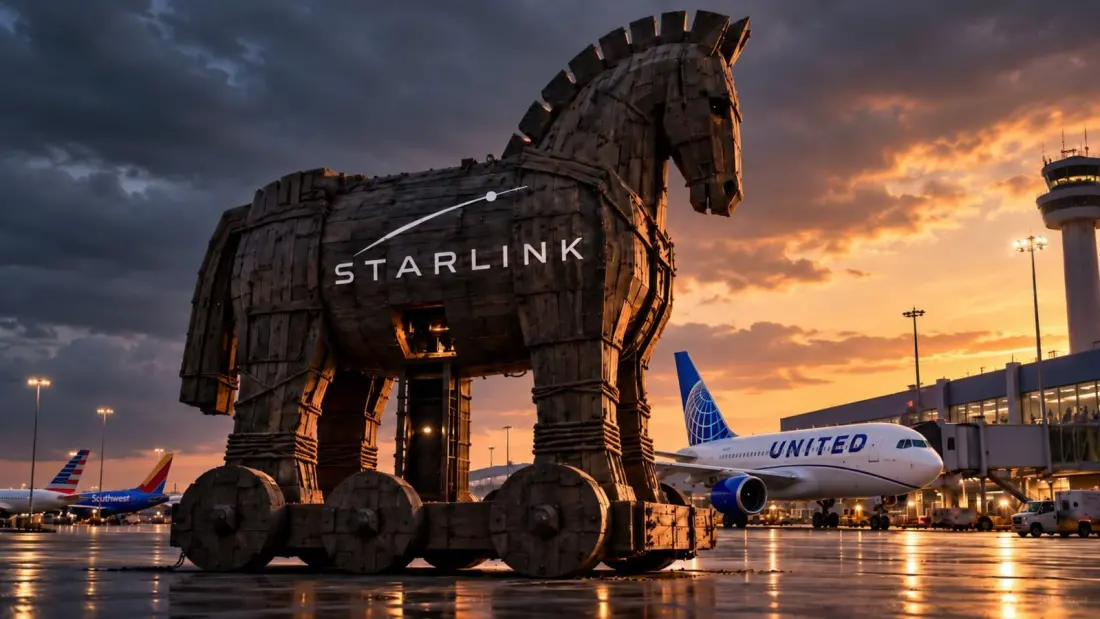
Airlines are rushing to install Starlink Wi-Fi, and passengers love it. United, Southwest, American and others have adopted the satellite service, which delivers fast, genuinely usable internet in the air — a leap ahead of the sluggish legacy systems travellers endured for years. But fresh reporting on Elon Musk has raised an awkward question: what happens when hundreds of aircraft depend entirely on a supplier who is one man?
The catalyst is a Telegraph report, based on four sources, claiming Musk personally proposed to Donald Trump that satellite service used by Ukrainian forces be restricted — and that Trump agreed. The restriction reportedly involved Starshield, SpaceX's military communications product, and affected the speed at which terminals can move while staying connected, disrupting drone and air-defence operations. That is a different product from the commercial Starlink that airlines buy, but the episode matters. Musk had previously assured the world, in March 2025, that he would never disconnect Ukraine or use the service as a bargaining chip. His later public explanation blamed limits on the US military and the president, which — if the reporting is accurate — conveniently left out his own role in proposing them.
This is where Delta's Ed Bastian starts to look shrewd rather than stubborn. Musk publicly attacked Delta and predicted Bastian would lose his job after reports that the Delta chief was reluctant to do business with him — much of it playing out on X, a platform Musk owns. Bastian denies the decision was personal; Delta's commercial ties with Amazon's competing connectivity offering also play a part. Still, the distinction between disliking someone's politics and judging their conduct a business risk is a real one for any CEO.
The worry is structural, not conspiratorial. Nobody is claiming Musk would switch off United's Wi-Fi mid-flight. The concern is leverage: an airline installs an excellent product, markets it heavily, trains passengers to expect it — and then a fleetwide rollout becomes very hard to unwind. Swapping an aircraft connectivity system means new hardware, installation, regulatory approvals and grounded planes. Even watertight contracts eventually expire, and a supplier that dominant negotiates renewals from strength. Anyone who wants a reminder of how quickly Musk can change commercial terms need only look at Tesla, which raised its Full Self-Driving package from $12,000 to $15,000 with about three weeks' notice in 2022.
For travellers, the takeaway is less about politics than about competition. Healthy rivalry — Starlink, Amazon Leo, Viasat and others — keeps prices in check and gives airlines an exit if terms sour. Delta may pay a short-term price if its Wi-Fi lags behind rivals, but a market with several viable suppliers protects passengers far better than one where everyone flies on the same man's satellites. The technology is impressive. The dependency is the risk. This piece draws on reporting by Live and Let's Fly.