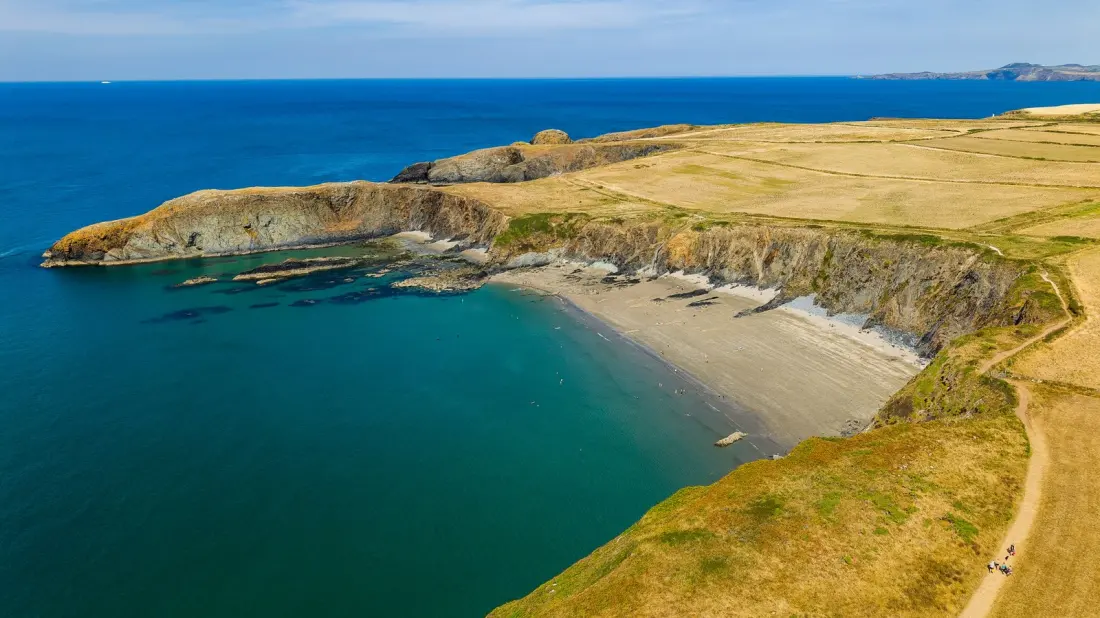
Most UK national parks are all about mountains and moors. Pembrokeshire Coast National Park is the odd one out — the only one in Britain designated chiefly for its coastline. It arcs around the far south-western corner of Wales in a loose U-shape, stretching from St Dogmaels in the north down to Amroth on the south coast, and packs in golden beaches, seal-haunted coves, puffin colonies and some of the most rewarding clifftop walking in the country.
The beaches are the headline act. Wales counts 10 Blue Flag beaches in Pembrokeshire alone, and the standouts are genuinely special. Barafundle Bay, ringed by dunes and oak woodland, is regularly voted among Europe's finest stretches of sand. Marloes Sands pairs pale sand with dagger-like rocks at one end and towering cliffs at the other. For those who like their beaches earned, Church Doors Cove near Manorbier is walled in by rock and reached only via a steep staircase, while Musselwick is a tidal bay you can walk to at low tide and often have entirely to yourself.
Walking is the best way to piece it all together. The Pembrokeshire Coast Path runs 186 miles along the park's edge, threading through fishing villages, Iron Age forts and some of the most dramatic shoreline in Britain. Fit hikers do the whole thing in about two weeks; most people sample it in day sections. The northern stretch between St Davids — one of the smallest cities on the planet — and Newport is the wildest, with 450-foot cliffs at Strumble Head, wild ponies grazing on top and seals in the swell below. Southwards, a two-hour loop around the Marloes Peninsula passes Iron Age ruins and looks out to Skomer Island, famous for its puffins in spring and early summer.
What elevates a trip here beyond scenery is the food and the towns. Solva is a pretty harbour village where you can pick up locally caught crab from Mrs Will the Fish, a much-loved seafood takeaway, and eat it straight off the beach. Over in Saundersfoot, The Stone Crab turns out smoked mackerel and seared bream. Tenby, with its pastel houses and historic walls, and tiny St Davids make good bases.
Getting there is straightforward: Cardiff Airport is the main international gateway, about two hours' drive away via the A40. Direct trains run from Swansea to Fishguard in the north of the park, with other services serving Tenby on the south coast. A car gives you the most flexibility for the remoter coves, but the rail links mean a car-free trip is workable if you base yourself in one of the bigger coastal towns.
This is a park for people who like their holidays salt-air flavoured: walkers who want big views without Alpine effort, families after safe sandy beaches, wildlife spotters chasing seals, porpoises and puffins, and anyone who believes a good hike should end with crab and chips. Go between late spring and early autumn for the best mix of weather, wildlife and pub gardens.