In Lebanon, the coffee isn't finished when the cup is empty — that's when it really gets going. Someone flips the cup upside down onto its saucer, waits a minute or two, then starts pointing out shapes in the grounds: a winding road, a bird, a letter that means someone important's name starts with M. Coffee cup reading is a fixture of Lebanese social life, and it's as much about stretching the conversation as it is about predicting anything.
What makes the tradition interesting is who does the reading. It's rarely a professional. More often it's an aunt, a neighbour or a friend who picked up the skill from a relative and reads cups at home for fun. One reader described to Lebanon Traveler how she learned from her cousin and now reads for friends and family — never for money. The practice passes informally from person to person, with no rulebook, and interpretations differ between families. The same habit of reading grounds runs through coffee cultures across the wider region, where the cup has always been tied to hospitality and time spent together.
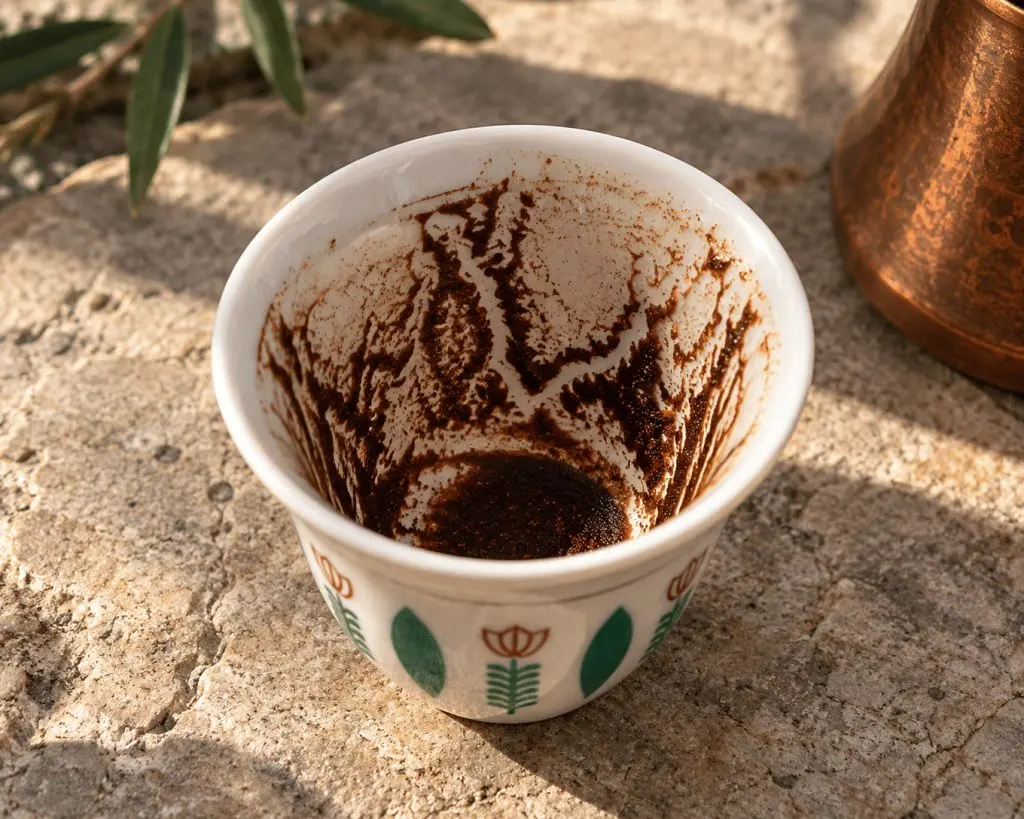
The mechanics are simple. Lebanese coffee is made with finely ground, unfiltered beans, so a layer of sediment settles at the bottom. After the last sip, the drinker flips the cup onto the saucer; as the remaining liquid drains, the grounds slide down the sides and leave lines, blobs and symbols behind. A white interior makes patterns easier to spot, and the handle works as a reference point.
Where a shape appears can matter as much as the shape itself, in some traditions. The area near the handle is linked to love and relationships, the left side to the present, the bottom to home and family, the spot opposite the handle to money, and the right side to the future. Letters might hint at initials of people or places; numbers, at an age or a date. A clean straight line suggests a clear path or a trip ahead, a wavy one means uncertainty, and a scatter of dots can be read as news, messages or travel. A heart means love, a bird means news coming, a road means a journey. Two people looking into the same cup will often see completely different things — and that's rather the point.
For travellers, this is a genuinely easy cultural experience to join. Order a coffee anywhere in Beirut or the mountains, and if you're with locals, chances are someone will offer to read your cup. You don't need to believe a word of it; the pleasure is in the debate it sparks around the table. It's a window into how seriously Lebanese culture takes coffee — not as a caffeine hit but as a reason to sit still, talk, and stay a little longer.