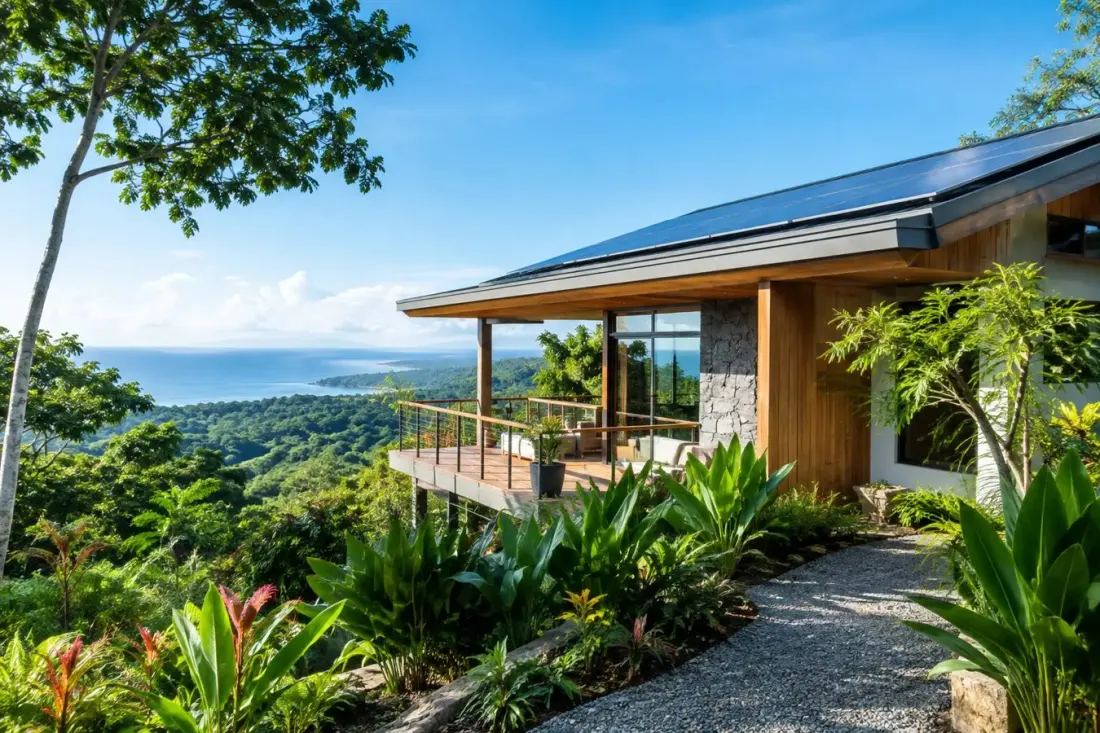
A glass-walled villa facing the Pacific sunset looks unbeatable in a listing photo. Then the rainy season arrives, wind drives water sideways for hours, and weeks of tropical heat test every material choice. In Costa Rica, sustainable construction is less a lifestyle badge and more a matter of whether a house stays comfortable and affordable five years on.
The first big decision happens before any concrete shows up: the site itself. Building conditions vary wildly across the country — salt air on Guanacaste beaches, steep wet slopes in the Southern Zone, cooler mountain air in the Central Valley, tight urban lots near San José. How a house is oriented determines how much afternoon sun it takes, whether it catches the breeze, and how much earthmoving disturbs drainage and slopes. Flattening a hillside, builders warn, can undo the natural cooling and water management the land was already doing for free.
Passive cooling comes next, and it's the workhorse of tropical comfort: deep roof overhangs, covered terraces, high ceilings, and windows placed for cross-ventilation. Air conditioning still earns its keep in bedrooms and offices, especially on the humid coast, but the smarter play is to shade and ventilate first, then cool only the rooms that need it. Big windows are fine — they just need exterior shading, screens, or plants so they don't turn a living room into a greenhouse.
Roofs carry the heaviest load here: sun, wind, salt, falling branches and torrential rain. Reflective surfaces, real insulation and drainage designed for actual rainfall matter more than looks, and rainwater harvesting can supply irrigation and outdoor washing if storage, filtration and mosquito control are planned from day one rather than bolted on later.
Water, in fact, is the conversation that matters most. In many communities, the legal water source and wastewater capacity decide what a property can realistically support — especially for rental homes and small hotels that host far more people than a typical residence. An undersized septic or treatment system doesn't just fail privately; it can affect neighbours' wells, streams and beaches. Low-flow fixtures and native, drought-aware landscaping are easy wins; a thirsty suburban-style lawn under tropical sun is not.
Materials and energy round out the picture. Concrete and steel make sense in a seismic country but carry a heavy footprint, so the question is where they're truly necessary. Local timber, stone and clay often beat imported "eco" products that face shipping costs, customs delays and crews unfamiliar with installing them. Solar power fits well into Costa Rica's already-renewable grid — but only after efficiency measures, and sized to real consumption rather than marketing ambitions.
For overseas buyers, the honest trade-off is upfront cost. Better windows, shading, water systems and careful site work aren't the cheapest route on day one, but they pay back through lower bills, fewer repairs and stronger rental appeal. Permits and qualified local professionals — architect, structural engineer, water and soils specialists — should be in the room early, and operating-cost estimates matter as much as construction quotes.
The end goal, as the piece puts it, is a different kind of luxury: a terrace where doors slide open, a roof that handles the rain loudly and well, a fan over a long lunch. Anyone weighing a purchase or build in Costa Rica will get more from these practical questions than from any rendering.
Howler Costa Rica