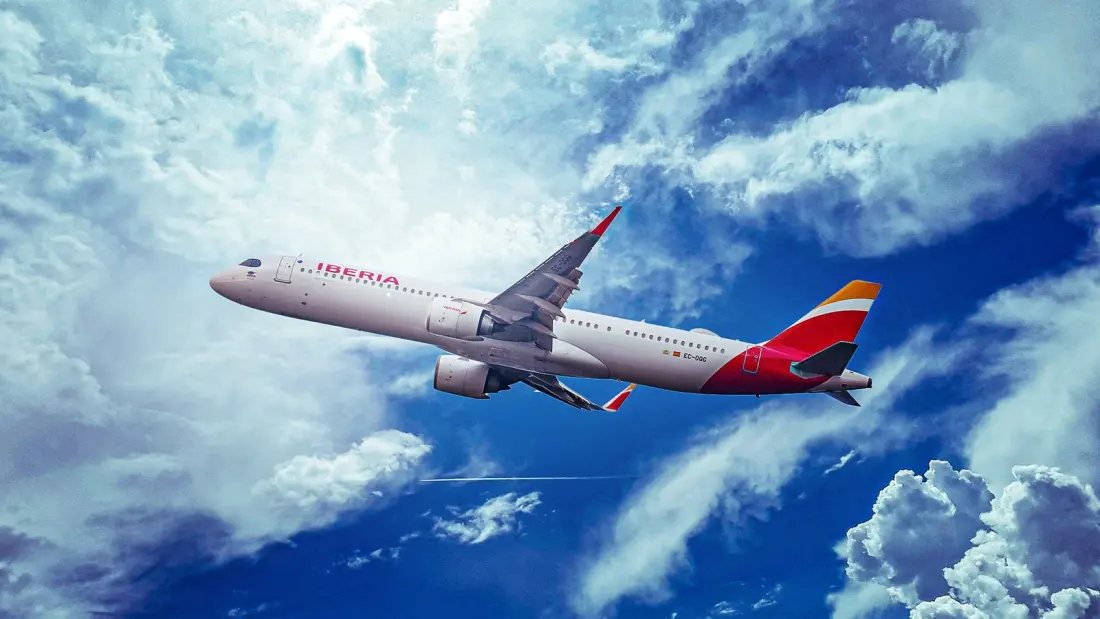
A single-aisle jet with a range of up to 4,700 nautical miles is reshaping which cities get nonstop long-haul service — and how often. The Airbus A321XLR, with roughly 180 seats and lie-flat business seats, is letting airlines fly routes that once demanded an A330 or Boeing 787, especially on days when a big twin-aisle would fly half-empty.
Iberia is the trendsetter. It operated the first commercial long-haul A321XLR flight on November 14, 2024, from Madrid to Boston, a route previously served by A330s. Boston lacked the connecting traffic to justify a widebody year-round, so the smaller jet let Iberia keep the nonstop link without excess seats. It has since grown to two daily flights, with widebodies returning for peaks.
The same logic now applies on bigger routes. From October 26, 2025, one of Iberia's two daily Madrid–New York JFK flights swapped an A330 for the XLR — a partial substitution that frees the widebody for busier sectors while keeping schedule choice intact. Madrid–Washington Dulles went further: once a seasonal route, it now runs year-round, with around five narrowbody flights and two A330 services in some periods, sized to demand.
Air Canada is using the XLR to test a thinner market. Its new Montréal–Berlin service launched in July 2026 on a Boeing 787-8, then switched to the 182-seat XLR on July 19, operating three times weekly. Berlin has far less transatlantic connectivity than Frankfurt, London or Paris, so a smaller aircraft makes the experiment affordable — and the route is set to return in summer 2027 with up to four weekly flights. Air Canada's XLRs feature 14 Signature Class lie-flat seats in a 1-1 layout, so the premium experience survives the gauge change.
The most extreme example belongs to IndiGo. On October 25, 2026, it replaced the leased Norse Atlantic Boeing 787-9 on Mumbai–Amsterdam with an A321XLR, creating the world's longest scheduled XLR route by block time — roughly 11 hours westbound. Airspace restrictions over Russia, Ukraine and Iran force longer routings, pushing the sector close to the aircraft's practical limits; at one point IndiGo even planned to cap bookings below 140 passengers on its 195-seat jet to save fuel weight. That frequency cut was later reversed, and the route is daily again for winter 2026/27, with IndiGo's own A350-900s expected from 2027.
For travellers, this shift matters in two ways. Smaller aircraft mean more nonstop options to secondary cities — Berlin, Boston, Washington — that might otherwise lose service or never get it at all. But cabin layouts vary more than before: an XLR business cabin has direct aisle access for everyone, yet fewer seats and a narrower fuselage than a widebody. On mixed-equipment routes, it's worth checking which aircraft operates your specific date before booking if flat beds or cabin space are a priority.
The A321XLR isn't killing the widebody — it's freeing it up. A330s and 787s are being redistributed to routes where their seats actually sell, while the small jet keeps frequencies alive everywhere else. Expect more city pairs to follow this template.