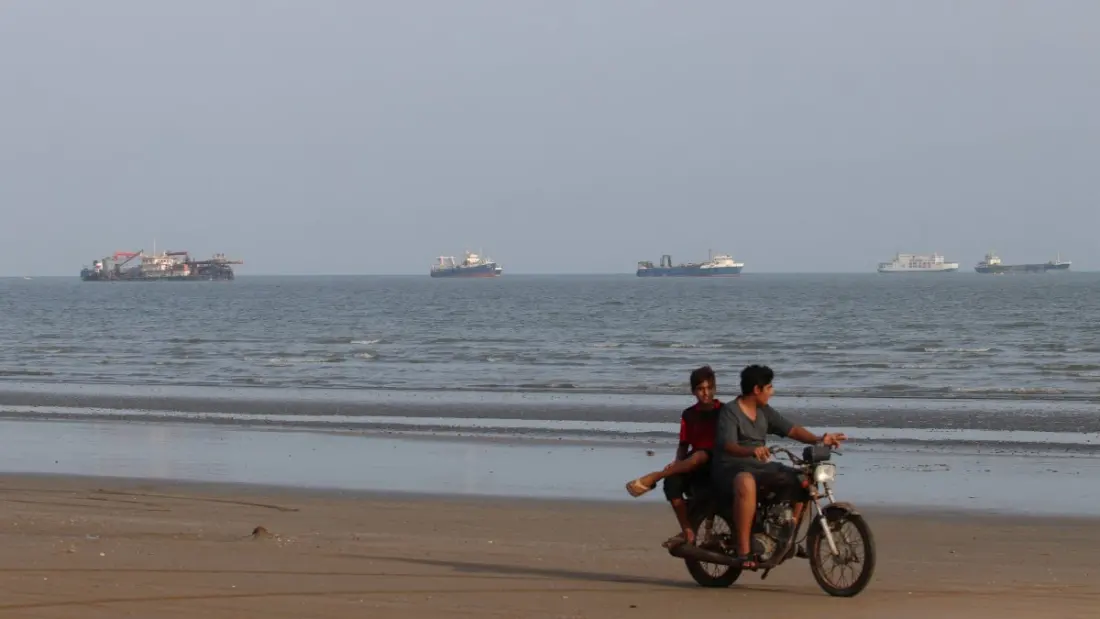
Three oil tankers exploded and caught fire in the Strait of Hormuz on Sunday, according to Iran's Revolutionary Guard, the latest in a string of shipping incidents that have turned one of the world's busiest waterways into a no-go zone for vessels travelling outside Iranian-approved channels.
The Guard said the three "non-compliant" tankers blew up while sailing through what it called an illegal channel, without naming the ships or their owners. Since a war with Israel began in late February, Iran has severely restricted traffic through the strait, targeting ships that pass without permission. The United States has responded with a naval blockade on Iranian ports and escorts for tankers — the strait normally carries oil equal to roughly one-fifth of global consumption.
Other incidents piled up over the weekend. UK Maritime Trade Operations reported a tanker on fire off Khasab, in Oman's Musandam exclave, with its crew evacuated, plus a second vessel hit by an unknown projectile. Emirati state media said 22 people were rescued from a burning ship in the Gulf of Oman and are in stable condition. Separately, Iran's own news agency reported explosion-like sounds in Qeshm, Sirik, Jask and Bandar Abbas, with an "impact" confirmed in Jask.
The broader picture remains tense. Israeli Defence Minister Israel Katz said the "mission is still not complete" against Iran, repeating claims that Tehran is pursuing nuclear weapons, which Iran denies. Israeli Prime Minister Benjamin Netanyahu has repeatedly threatened new strikes, though it's unclear whether Washington — where President Trump took a midterm battering partly over the war — would back another offensive. There were also unconfirmed reports that a Mossad operation against Iran was blocked by the US ahead of Israel's October election, which ended with Netanyahu's rival Gadi Eisenkot tasked with forming a government.
For travellers, the practical takeaway is straightforward: the Gulf is not currently a calm corner of the world. Cruise itineraries through the Strait of Hormuz, dive trips around Oman's Musandam Peninsula, and city breaks in Dubai or Abu Dhabi could all be affected by further escalation, port closures or airspace restrictions. Anyone with bookings in Iran, Oman, the UAE or nearby should monitor their foreign ministry's travel advisories closely, keep an eye on maritime security notices from UKMTO, and check directly with airlines and cruise operators before departure rather than relying on older itineraries. If the region is on your list, this is a moment for flexibility — refundable bookings and travel insurance that covers disruption are worth the extra cost.