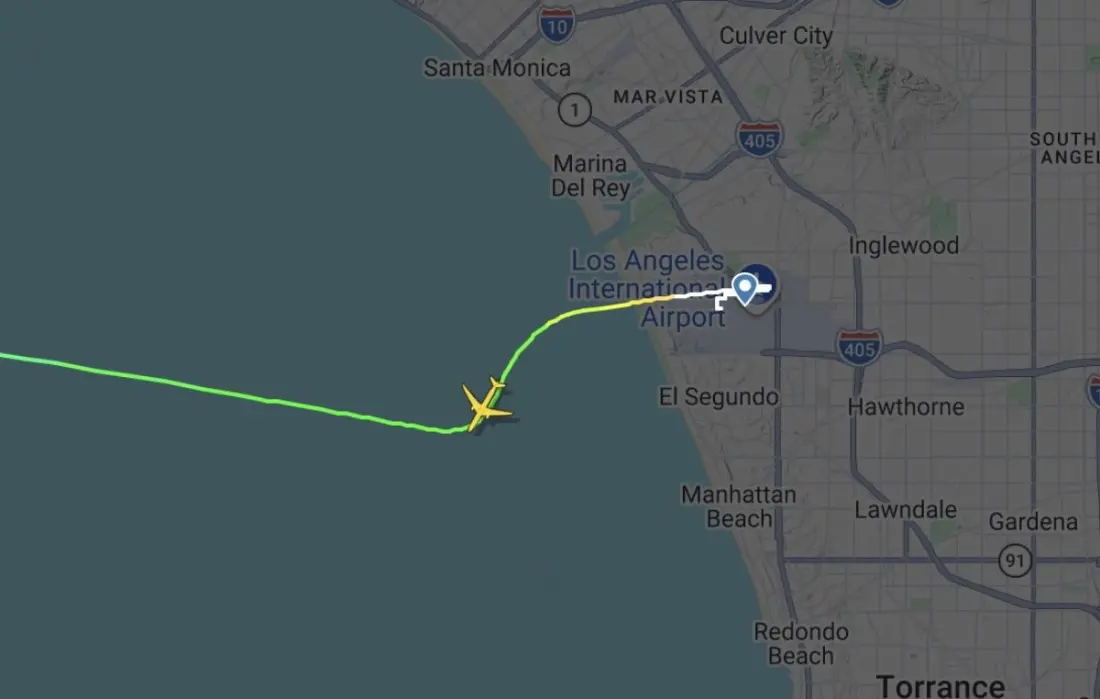
Shortly after midnight on Saturday, November 7, 2026, Air France flight AF28, an Airbus A350 heading to Papeete in French Polynesia, was cleared for takeoff from runway 24L at Los Angeles International. The pilots read back their instructions correctly: after the DLREY fix, climb via the assigned departure procedure. Then, minutes into the flight, they banked left — straight into the departure path of an American Airlines A321 that had just taken off from runway 25R, on the south side of the field.
Air traffic control caught it fast and issued a traffic alert. Separation between the two aircraft dropped below a mile. Uncomfortably close for two jets climbing out of the same airport at night.
What happened next is arguably as worrying as the mistake itself. Asked why they turned, the Air France pilots replied "standby." Asked again which departure they were flying, they stalled again and never really answered. In fairness, pilots are trained to fly the aircraft first and talk second, and the controller might have shown a touch more patience. But the question was simple, and the silence dragged. The crew eventually collected a phone number — aviation shorthand for a possible pilot deviation investigation.
The puzzle is why the turn happened at all. A westbound overnight departure to Tahiti requires essentially a straight-out climb; there's no sensible reason to vector east. One theory: crews programme their onboard computers for a runway 25R departure, then get assigned 24L at the last minute, and the mismatch plays out in the air.
Here's the part that should raise eyebrows: this exact pattern keeps repeating. A couple of weeks before this incident, a TAP Air Portugal A330neo leaving from the same runway, 24L, made an unauthorised left turn right after takeoff into another jet's path. Two months before that, an Air France Boeing 777 did nearly the same thing. Same runway, same wrong turn, multiple airlines. That suggests something systemic — runway assignment procedures, chart design, or how the parallel runways at LAX are communicated — rather than one sloppy crew.
For travellers, this isn't a reason to avoid LAX: controllers caught the error in seconds, and mid-air close calls at major US airports remain extraordinarily rare. But it's a useful reminder that the busiest four-runway operations still depend on human coordination under pressure, and that the FAA and airlines clearly have a procedural problem worth fixing on the north side of LAX. The likely fix is almost comically simple — controllers explicitly warning crews off a left turn after 24L departures — but if it stops the pattern, silly-sounding may be exactly what's needed.
Story via One Mile at a Time.