
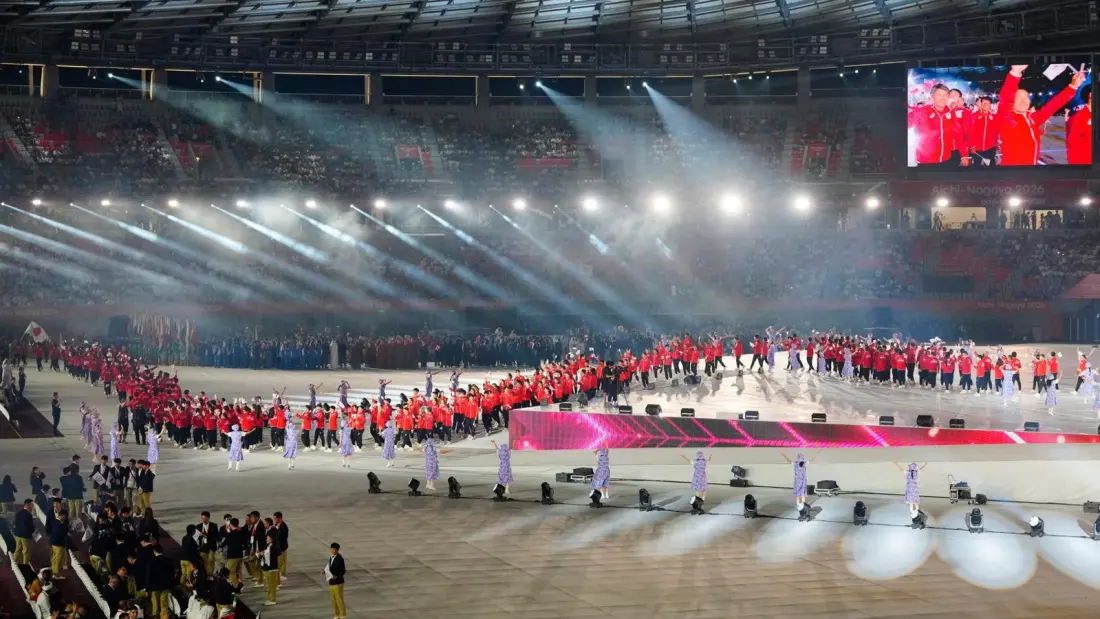
Japan's third-largest city is now the centre of Asian sport. The Asian Games officially opened at Nagoya City Stadium on Saturday, kicking off 16 days of competition featuring at least 11,000 athletes from 45 countries and regions — more than the roughly 10,700 who competed at the Paris Olympics. In fact, the Games outgrew their own opening ceremony: basketball started over a week early, with soccer close behind, because the packed schedule simply couldn't wait.
Forty-three sports are on the programme. Alongside the familiar track, swimming and soccer events, there are regional specialities most visitors will never have seen live: kurash, an ancient Uzbek wrestling form; kabaddi, essentially team tag with contact; and sepaktakraw, a spectacular blend of volleyball and soccer played with feet and head. New additions this time include mixed martial arts, padel, teqball and esports — a big reason the calendar got so crowded.
Japan fields the largest delegation at 933 athletes, with China close behind at just over 800. China is expected to dominate again after winning 201 golds at the last edition in Hangzhou in 2023, when Japan took 52 and South Korea 42. The ceremony itself, themed "Harmonic Heart Beat" with a giant heart-shaped stage, drew Emperor Naruhito and Empress Masako, new Olympic Council of Asia president Sheikh Joaan bin Hamad Al Thani, and IOC president Kirsty Coventry.
The buildup hasn't been entirely smooth. Skipping a dedicated athletes' village to cut costs, organisers are housing around 17,000 athletes and officials on a cruise ship, in hotels and in converted wooden containers — and some competitors have grumbled about small rooms and leaky huts. Venue logistics are spread across the Nagoya region, home to about 9.5 million people roughly 350 kilometres south of Tokyo. Politics also crept in: the North Korean anthem was mistakenly played at a South Korea field hockey match, and Taiwan's sports minister, two-time badminton Olympic champion Lee Yang, was briefly blocked from a welcoming ceremony before being allowed in. Taiwan competes as Chinese Taipei, as it does at the Olympics.
For travellers in or near Japan, this is a rare chance to watch kabaddi or sepaktakraw in person without flying to a dedicated world championship, and tickets for niche sports are typically far easier to get than athletics finals. Nagoya itself makes a solid base — compact, well connected by shinkansen between Tokyo and Osaka, and packed with excellent food culture, from miso katsu to hitsumabushi eel. Even if you miss the Games, the city's scale and transport links make it an easy add-on to a standard Japan itinerary.
The Games run for another two weeks, so there's still time to catch the less familiar sports — arguably the best reason to go.
Story via Japan Today.