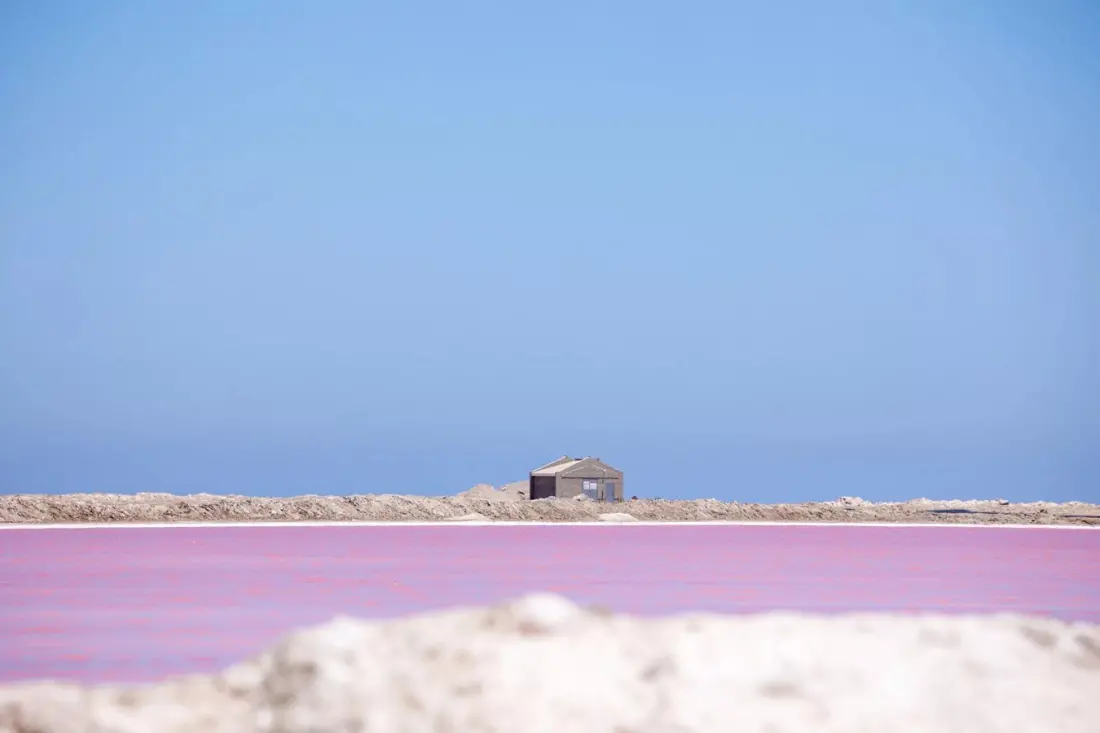
South Africa's salt pans look like the flattest, emptiest places in the country — cracked white crusts under enormous skies. But when conditions line up, some of them flood with water that turns startling shades of pink, orange and red. The catch: it's temporary, and you can't book it like a hotel.
The explanation is biology, not magic. Salt pans form in shallow depressions where water collects and evaporates, leaving salts and minerals behind. Once the water gets salty enough, salt-loving microorganisms — halophiles such as bacteria and archaea — start thriving and producing pigments. Add in Dunaliella salina, a microscopic alga that pumps out beta-carotene (the same pigment that makes carrots orange) under extreme salinity, and you get water in warm hues that looks almost artificial.
Which colour you see depends on a shifting mix of salinity, rainfall, sunlight and which species are present. Different organisms produce different pigments, so one pan can look pink while its neighbour burns deeper orange or red. Rain complicates things further: a dry pan may fill after a storm, then change appearance again as the water evaporates. A pan that's vividly coloured today can look completely ordinary a few months later. Timing is everything, and even then there are no guarantees.
The good news is you don't need a flight to Bolivia or Australia to see these landscapes. South Africa has salt pans across its drier interior and coast. Soutpan, north of Bloemfontein in the Free State, is a salt-mining town whose hyper-saline water has been studied for its unusual bacteria — a 2017 paper in Molecules documented the diversity of life living there. The Pretoria Salt Pan, about 40km northwest of the capital, is a near-circular geological curiosity with a long, puzzling formation history. And on the West Coast, the village of Yzerfontein, roughly 80km north of Cape Town, has salt-pan heritage of its own: salt was once carted to the coast there for shipping.
None of these are guaranteed pink-water viewpoints, and the article is clear about that. Treat them as destinations for the landscapes themselves — vast, stark, photographic — with the chance of colour as a bonus if the season and salinity cooperate. Before setting out, check access arrangements, since some pans sit on working salt mines or private land.
What makes these places worth the detour is exactly what makes them easy to underestimate. They look dead, but they're full of microscopic life quietly adapting to conditions that would kill most organisms. When that life gets loud enough to change the colour of the water, you get one of the strangest natural spectacles in the country — no filter required. If you're road-tripping the Free State, Gauteng's fringes or the Cape West Coast, a salt pan stop costs you an hour and might hand you the most surreal photo of the trip.
Reported by Getaway South Africa.