A short drive from Modena, in the small town of Campogalliano, stands one of Italy's strangest pieces of automotive history: the abandoned factory where Bugatti tried to reinvent itself in the early 1990s.
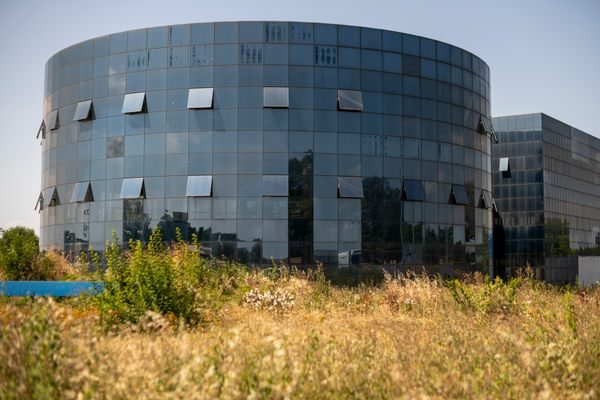
The story begins with ambition. Bugatti, the legendary French-marque-turned-Italian-venture, planned a full comeback with the EB110, a quad-turbocharged supercar that would take on Ferrari and Lamborghini at their own game. To build it, the company erected a facility that looked nothing like the smokestack-era car plants of the day. Its buildings were painted a distinctive blue, wrapped in wide glass walls, and fitted out with facilities so advanced that contemporaries described the complex as something out of science fiction. While other factories leaned industrial and grim, this one was meant to signal the gleaming future of Italian supercar manufacturing.
The future lasted about four years. Bugatti Automobili collapsed into bankruptcy in 1995, undone by debt and a supercar market too small to sustain the dream. The EB110 became a rare collector's item, and the futuristic campus became an orphan: too modern to demolish without a thought, too specialised to easily reuse.
What followed is the part that draws travellers today. The site sat abandoned for years, its production halls empty, its glass and blue facades weathering in the Emilian countryside. Urban explorers and photographers began seeking it out, drawn by the contrast at its heart. This was a place built to showcase cutting-edge technology, now functioning as a memorial to a company that barely survived half a decade. Walking the perimeter, you can still read the ambition in the architecture — the scale of the halls, the optimism of the design — and picture the EB110s that rolled out of here before the money ran dry.
There's a fitting irony in the location, too. Campogalliano sits in Italy's Motor Valley, the stretch of Emilia-Romagna that also hosts Ferrari in Maranello, Lamborghini in Sant'Agata Bolognese, Pagani in San Cesario sul Panaro and the Enzo Ferrari museum in Modena itself. Most visitors tour the shining, working museums and never realise that one of the region's most compelling automotive stories is a ruin — a cautionary tale parked quietly next to the success stories.
Worth knowing before you go: this is private property, not a curated attraction. There are no ticket booths or guided tours by default, and conditions around access change over time. The complex is best appreciated from publicly accessible viewpoints, and entering restricted areas without permission is off-limits — however photogenic the interiors look on social media. Treat it as you would any industrial heritage site: admire from outside unless official access has been arranged.
For travellers, the appeal is obvious. If you're already in Modena for balsamic vinegar, Osteria Francescana or the Ferrari museums, Campogalliano is a short detour that adds a genuinely different note to a Motor Valley itinerary — less polished, more melancholy, and a reminder that even the boldest dreams in the supercar world can end in silence and empty glass halls. It pairs naturally with a day spent among the region's working ateliers: history triumphant on one side of the road, history abandoned on the other.
Story via Atlas Obscura.