
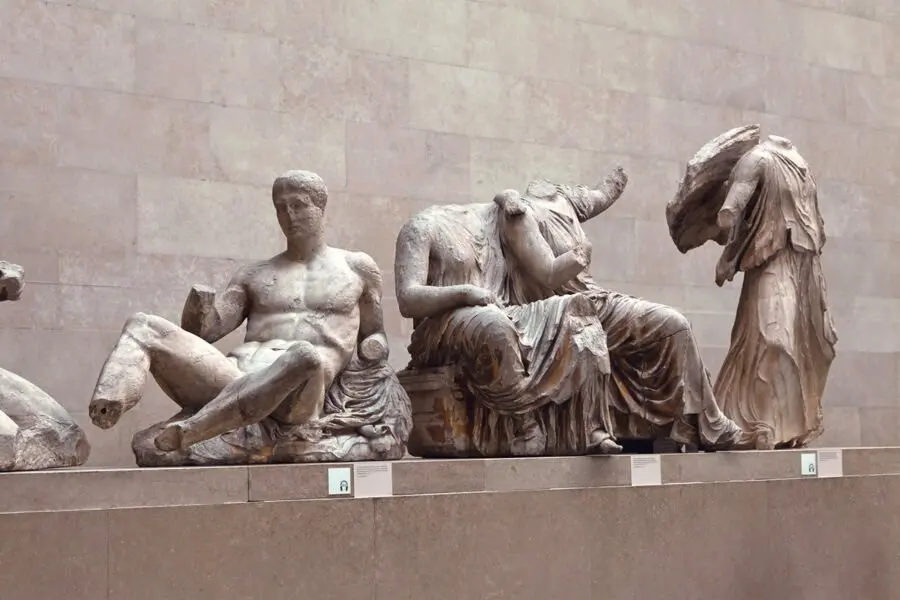
The Parthenon survived nearly intact for two millennia — until 1687, when Athenian defenders stocked the temple with gunpowder during a siege. The blast blew the building apart, and in 1801 the British ambassador Lord Elgin hauled off the most treasured surviving sculptures to London. Those carvings, the Elgin Marbles (or Parthenon Sculptures), still fill a purpose-built gallery at the British Museum, and they remain one of the best reasons to carve out an afternoon there.
What you're looking at is mostly the 500-foot frieze carved around 430 BC, which once ran along the top of the temple. It depicts the Panathenaic procession — the great annual parade up the Acropolis for Athens' birthday. The panels read like snapshots: riders wrestling with restless horses, flute players, dancing women, chariots, scampering children, priests leading oxen for sacrifice. At the centre are teenage girls in finely pleated robes carrying gifts for the gods — incense burners, jugs of wine, and the ceremonial robe presented to the temple's colossal 40-foot gold-and-ivory statue of Athena.
The craftsmanship still stuns. Muscles are defined, horse veins bulge, and the girls' drapery folds echo the fluting of columns while their strides feel entirely natural. Originally the whole frieze was painted in bold colours, and every figure's head sits at the same height, facing the same way — a single ribbon of humanity wrapping the temple.
The gallery also holds statues from the triangular pediment over the temple entrance, showing the gods at an Olympian banquet as Athena bursts from Zeus' split-open head — the key figure itself is lost, leaving an empty space at the peak. Then come the metopes, relief panels of Greeks brawling with centaurs: hair-pulling, shin-kicks and all, ending with civilised humans prevailing over the beastly half-horses. Athens had just emerged from a devastating war, and the Parthenon was its statement of recovery — reason over impulse, order over chaos.
For travellers, this matters twice over. In London, the gallery offers an up-close read of sculptures you'd otherwise squint at from ground level far below. And in Athens, seeing the Parthenon itself — its exterior stripped bare — gives the story a poignant second chapter. Greece has long campaigned for the marbles' return, and the purpose-built Acropolis Museum keeps the remaining frieze blocks with gaps facing the window slots where the London pieces belong. Pairing both collections in one trip is a genuinely moving way to see one of art history's great unfinished puzzles.
If you're planning a London visit, book the British Museum's free timed entry, head straight to Room 18 before the crowds build, and give yourself an unhurried hour with the frieze. Then, whenever you make it to Athens, climb the Acropolis early in the morning and imagine the procession — horsemen, dancers, girls with jugs of wine — once winding up that same hill.