
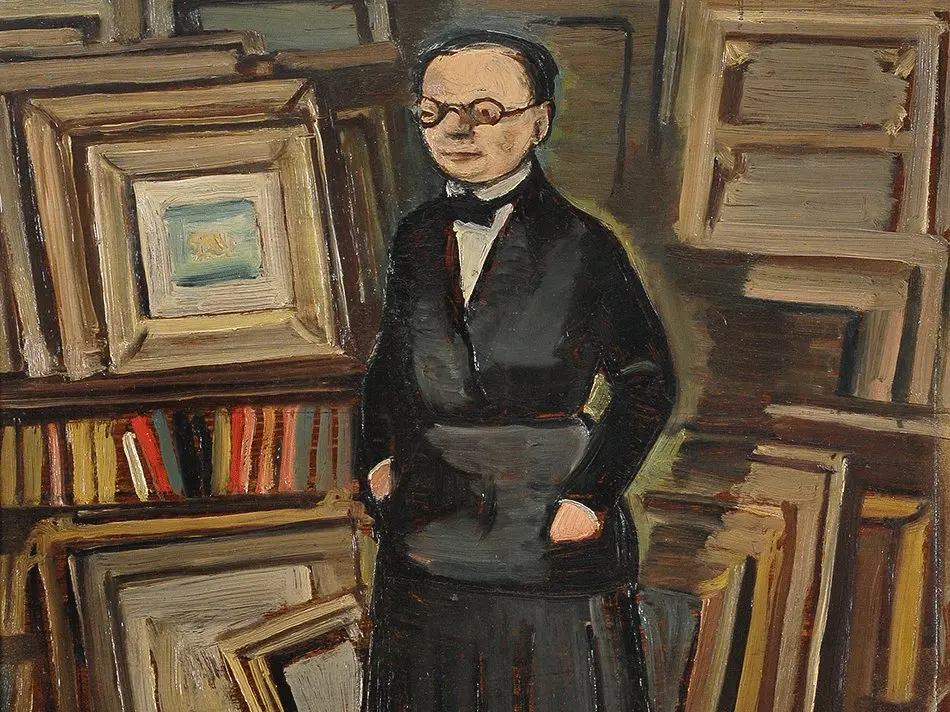
Paris art history tends to credit men like Kahnweiler and Vollard for launching Picasso and Matisse, but a scrappy gallery in Pigalle got there first. Berthe Weill, born in 1865 to an Alsatian-Jewish family, opened her gallery near Montmartre in 1901, funded with her dowry, and over the next four decades showed roughly 300 artists — including the first dealer sales for both Picasso and Matisse.
She met Picasso in 1900, latched onto his Paris nightlife painting Le Moulin de la Galette, and brokered his earliest sales to French collectors. Her 1902 show even pitted him head-to-head with another painter. She showed Fauvists like Derain and Vlaminck before the famous 1905 Salon d'Automne gave the movement its name, and in 1917 she staged the only solo exhibition Modigliani would see in his lifetime — 32 works, and a standoff with a police commissioner who demanded she remove his nude portraits. She refused.
Weill was equally ahead of her time on who got wall space. Of 149 solo shows at Galerie B. Weill, 29 went to women. She championed Suzanne Valadon with three retrospectives, showed Émilie Charmy's bold nudes in some 30 exhibitions, and gave Harlem Renaissance sculptor Meta Vaux Warrick Fuller a platform. Diego Rivera got his only Paris solo show under her roof, too. She also refused to keep politics out of the gallery, displaying pro-Dreyfus material during the antisemitic fever of the 1890s.
The war ended it all. Forced to close in 1940 under the Occupation, she hid in Charmy's studio; many of her peers weren't so fortunate. After the war, in her 70s and unwell, she never recovered her standing — her artists drifted to bigger male dealers, and her role in their rise was largely forgotten until a biography appeared in 2011. She died in 1951, aged 85, propped up by a 1946 benefit auction of works donated by friends and rival galleries.
Recent museum shows, including at New York's Grey Art Museum and the Musée de l'Orangerie in Paris, have restored her reputation, and her story gives visitors a fresh way to walk the city. Stand where her gallery stood in the Pigalle/Notre-Dame-de-Lorette quarter, then follow the trail: Montmartre's artist haunts, the Musée de l'Orangerie for the painters she backed, and the Modigliani works scattered through Paris collections. For art lovers, it's a reminder that the canon we see on museum walls was shaped by someone history nearly wrote out.