
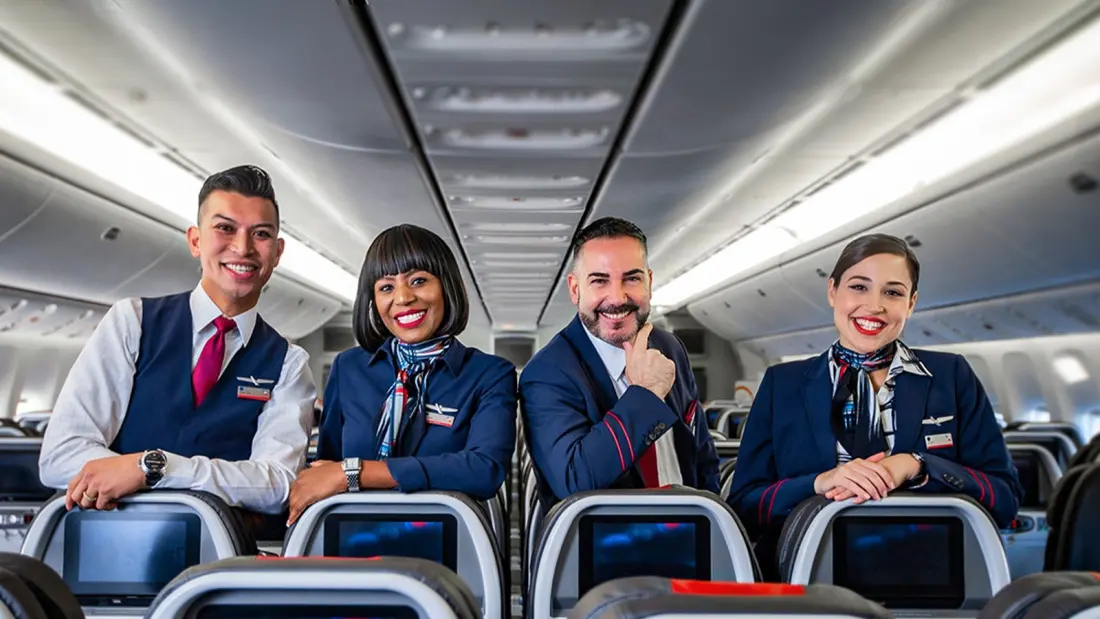
Next time you're on a long-haul Boeing 777, look up. Hidden above the ceiling, in the fuselage crown, is a windowless compartment most passengers never realise exists: the crew rest area, where cabin crew grab compulsory sleep in the middle of your flight.
On the 777-300ER, the space holds eight bunks in two rows of four, each roughly two metres long and 76 centimetres wide. They come with a padded mattress, seatbelt for turbulence, reading light, mirror, blanket and individual temperature controls. Access is deliberately discreet — at Cathay Pacific, crew climb a staircase behind a door disguised as a lavatory; at Air New Zealand, the entrance blends into the galley. Crew affectionately call them 'the coffins': cold, claustrophobic, and prone to worse turbulence near the tail.
It wasn't always like this. On older planes such as the Boeing 767, resting crew got a curtained-off row of economy seats — no lying flat, constant foot traffic to the lavatories. Regulations now demand far better. When a flight duty period runs past 14 hours, a flight attendant must get at least three hours of bunk rest, rising to 4.5 hours beyond 18 hours. Regulators class facilities in tiers: Class 1 is the enclosed bunk away from the cabin, Class 2 a curtained reclining seat, Class 3 a plain cabin seat.
How it plays out in practice: crew split into two shifts once meal service wraps, with the senior crew member assigning shifts — and bunks — largely by seniority. Junior crew reportedly take the smaller bunks. Silence is mandatory, alarms are banned, and crew wake each other manually. On an eight-hour London to Dubai flight, rest might be an hour or two; on a 14-hour London to Singapore run, closer to four and a half.
Airlines have good financial reasons to keep bunks out of the cabin. Boeing's crown-mounted design frees space equal to more than 16 revenue seats or a full cargo pallet on the main deck, while the whole lower deck stays open for freight. Collins Aerospace estimates that's worth between $4.9 million and $11.25 million in extra revenue per aircraft over 20 years, with a 66% weight saving over hold-mounted compartments like those on the A330 and A340.
Not every aircraft gets it right. Crew say the A380 is so quiet that cabin noise disturbs sleep, and the A321XLR's rest space — effectively curtained-off seats resembling a small tent, next to the lavatories — is widely disliked despite the jet flying up to 11 hours. Suppliers such as Diehl Aviation are testing fold-out twin beds and other modular designs that promise proper rest without sacrificing paying seats.
For travellers, this is a nice bit of aviation trivia and a reassurance: the crew serving your 14-hour flight are legally guaranteed real sleep, not a nap in a seat. Well-rested crew are safer crew — and next time you board a 777, you'll know exactly what that unmarked cupboard door is for.
Credit: Simple Flying