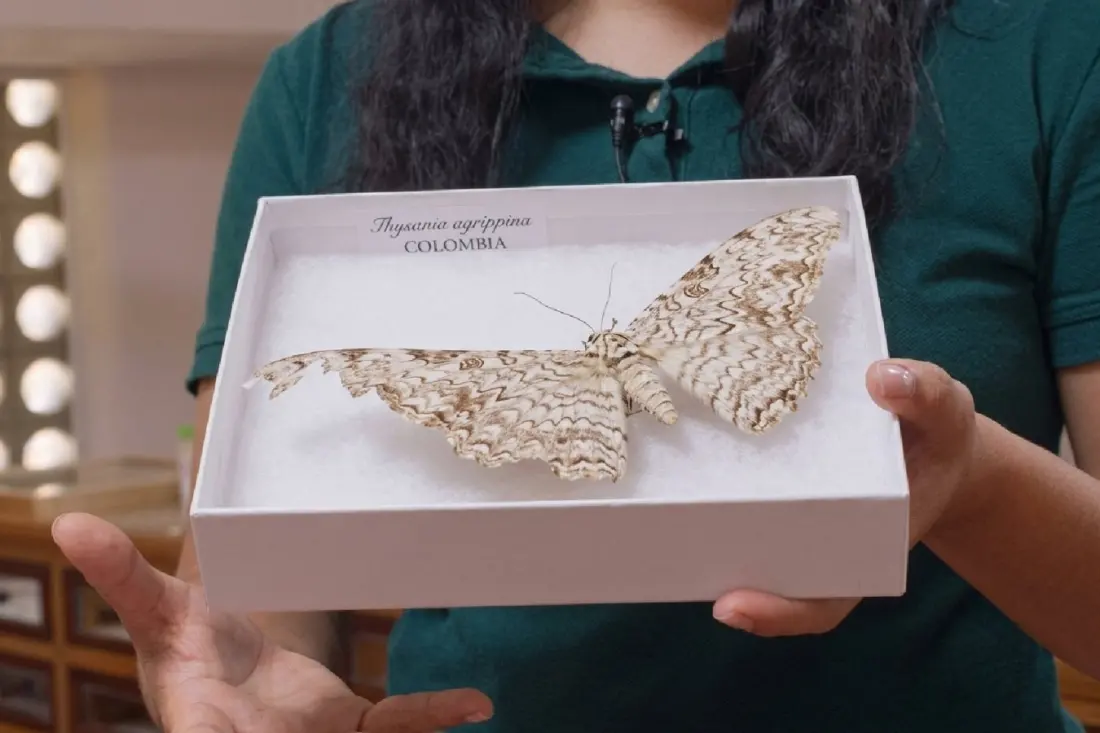
Deep in Colombia's eastern plains sits a moth so big it looks like something out of folklore. Thysania agrippina — known variously as the white witch, ghost moth, or great grey witch — can spread its wings up to 30 centimetres across, making it one of the largest moths on the planet. Its colouring of white, grey and brown, crossed with wavy hand-drawn-looking lines, is what gives it an eerie, spectral quality — and a long list of spooky nicknames.
The moth is a master of disguise. By day it rests flat against tree trunks, its patterned wings blending seamlessly into the bark so predators pass it by. After dark, it comes alive, flying through forests that stretch from Mexico all the way down to Uruguay.
One specimen has found a permanent home at the National University of Colombia's Orinoquia campus in Arauca, where biologist Laura Mojica Candela curates the Orinoquia Entomological Collection. She notes it's easily the largest moth preserved there. The collection, started in 2012 by professor Nestor Fernando Perez, documents the insect life of the Llanos — the vast tropical grasslands of the Orinoco Basin — alongside a companion herbarium of regional plants.
The scale of the project is impressive: a dataset published in May 2022 holds 9,292 biological records, covering everything from butterflies and beetles to bees, wasps, ants and dragonflies, drawn from Colombia and Venezuela. It's all publicly accessible through international biodiversity platforms, a rare window into one of South America's least-studied regions.
For travellers, the white witch is a reminder that Colombia's appeal goes well beyond coffee farms and Caribbean beaches. The Llanos — especially around Arauca and the wider Orinoquia — offer savannah landscapes, cattle-ranching culture, exceptional birdwatching and a sense of wildness you won't find near Bogotá. Spotting a white witch in the wild is a long shot given its camouflage and nocturnal habits, but night walks with local guides in forested areas of the plains occasionally turn up remarkable moths, and even the possibility of this giant adds a thrill to the experience.
Nature-focused travellers, insect enthusiasts and anyone chasing off-the-beaten-path South America should file this one away. Arauca remains genuinely under-visited, which is precisely its charm — you'll share the trails with researchers and cowboys rather than tour groups.