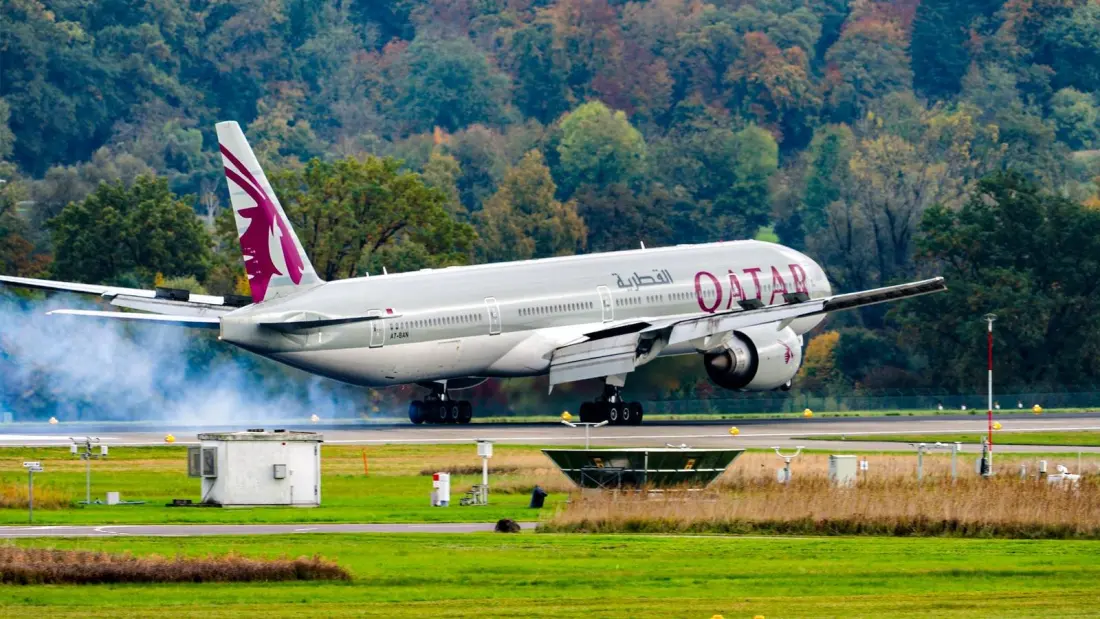
The Boeing 777-300ER turned 20-plus years old a while back, yet it still flies some of the longest nonstop routes on the planet. With more than 2,000 delivered, it remains the best-selling widebody ever, and Cirium schedule data for 2026 shows it anchored to ten marathon routes — mostly linking Asia and the Middle East with North America.
The list is bookended by Air India's New York–Mumbai run at 6,774 nautical miles and, at the top, Cathay Pacific's Hong Kong–New York service at 7,014 nautical miles. In between sit Emirates' Dubai–Miami (6,817 nm) and Dubai–Dallas/Fort Worth (6,987 nm, the airline's longest 777-300ER route), EVA Air's Taipei–Houston and Taipei–New York, China Southern's once-weekly Guangzhou–New York, and two more Air India services to the New York area.
A few practical details jump out for anyone booking these flights. Air India's recent ex-Etihad 777-300ERs are the ones to pick if you can: they have staggered business class seats with direct aisle access, versus the dated seven-abreast layout on the airline's original 13 aircraft. The trade-off is economy — the ex-Etihad planes cram in ten seats per row, while the older ones keep a roomier nine. Airspace bans over Pakistan and the Middle East have also wrecked some of Air India's westbound sectors: Mumbai–New York now stops in Rome for fuel, and the San Francisco–Delhi service makes a technical (no-disembark) fuel stop in Kolkata on the return.
Over the Pacific, Taipei–New York is the only route flown by two carriers, EVA Air and China Airlines, both with solid reverse-herringbone business seats. EVA's JFK subfleet is the comfier budget pick, with nine-abreast economy against China Airlines' ten. EVA uses the same friendly aircraft on its decade-old Taipei–Houston route — arguably the most comfortable ultra-long-haul economy experience on a 777 anywhere. Cathay runs three daily Hong Kong–JFK flights, one on the 777-300ER, the rest on A350s.
Two Emirates quirks are worth knowing. Miami, only served since 2021, gets the 777-300ER in the northern summer with an eight-seat first class cabin, and the flight continues on to Bogotá with the same flight number — a five-freedom tag-on that makes Emirates' widebody the most comfortable way between Miami and Colombia. At Dallas/Fort Worth, Emirates is rolling out retrofitted 777s with the new direct-aisle business seats and premium economy, fixing the long-criticised seven-abreast layout. China Southern's Guangzhou–JFK route, once weekly under the current 50-flights-per-week US–China bilateral cap, is a rare remnant of pre-pandemic scale, and it too keeps nine-abreast economy.
The takeaway for travellers: aircraft type still matters enormously on 14-hour-plus flights, and the same model can differ wildly airline to airline — even within one airline's fleet. Check the seat map before you book any of these routes.