Forget Mutianyu and Badaling. The Ming Dynasty's Great Wall actually begins at Tiger Mountain, near the border city of Dandong in Liaoning Province, where the ramparts run along a ridge overlooking the Yalu River — and North Korea beyond it.
For centuries people assumed Shanhaiguan, near the Bohai coast, was the wall's eastern terminus. That changed in 1990, when archaeological work confirmed the wall stretches all the way to the Yalu. The fortifications at Tiger Mountain date to 1469, built under the fifth year of the Chenghua reign with local sandstone and earth, and served as a military post guarding the Ming's northeastern frontier against incursions from the north.
What makes the site compelling today is what it isn't: it's not slick, rebuilt or mobbed with tour buses. The wall here is rough and original, winding along the mountain with heavy watchtowers and thick crenellations. From the towers you look out over the Yalu and the frontier lands on both sides. The site is in Hushan Village in Kuandian Manchu Autonomous County, roughly a 40-minute drive from central Dandong.
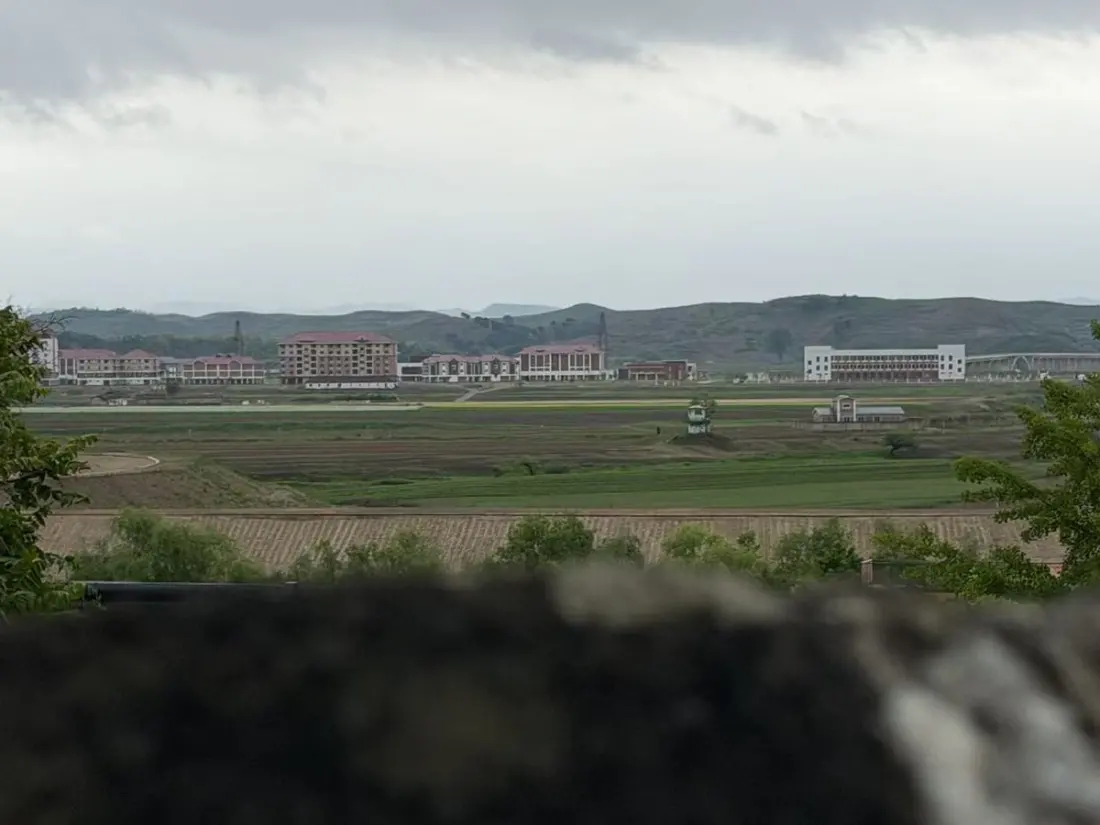
The quirk that draws the curious is the "one metre hop" — the narrowest point of the China–North Korea border, where a branch of the Yalu shrinks to a channel you could step across. Visitors can see the North Korean embankment built after flooding, relocated villagers' new houses and green farmland, and sometimes North Korean soldiers patrolling the far bank. At a time when North Korea itself remains closed to international travellers, this is one of the closest, most tangible ways to peer into the country without a visa.
For travellers, the appeal is a two-for-one: an atmospheric stretch of the Wall with real military history and barely any commercialisation, plus a rare borderland vantage point few international visitors ever reach. Dandong is a long way from Beijing — closer to the Korean peninsula than to the capital — so it suits anyone doing a northeast China route or a dedicated borderlands trip. It also offers something the restored Beijing sections can't: the sense that you're standing on the edge of the map, watching two countries carry on a few metres apart.