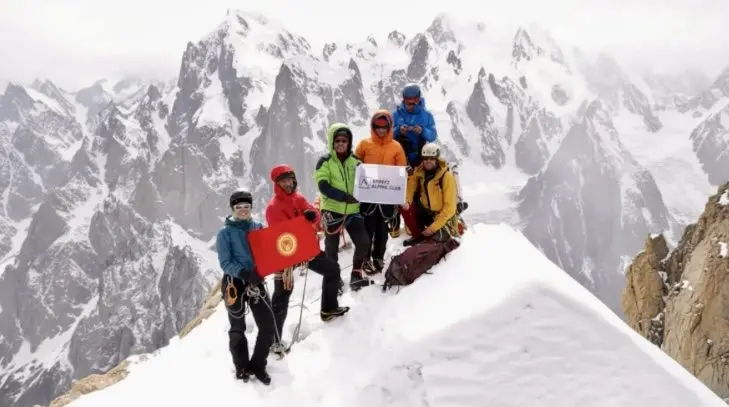
A piece of Karakoram climbing history has a new chapter. On September 28, a team from Kyrgyzstan reached the summit of Nameless Tower — the 6,239-metre granite spire in Pakistan's Trango group — by the legendary Eternal Flame route, the first time climbers from their country have done so.
The expedition was led by Mikhail Mikhailov, a serious name in big-wall circles. He was part of the 2004 ascent of Jannu's North Face that won a Piolet d'Or, and in 2009 he made the first ascent of Peak 6134 on Minya Konka with Alexander Ruchkin. Alongside him were Mikhail Danichkin, Timur Akbashev, Aidar Akbashev, Zarina Kutanova and Aleksei Pototsky.
Why does this route draw people back? Eternal Flame, first climbed in September 1989 by Kurt Albert, Wolfgang Gullich, Christof Stiegler and Milan Sykora, runs up the South Face of Nameless Tower for roughly 650 metres on a wall that rises about 1,000 metres in total. Graded VI, 7b+, A2, it demands sustained, hard free climbing — the kind usually found on European crags — combined with everything a 6,000-metre Karakoram peak throws at you: altitude, cold, unpredictable weather and serious logistics. That mix has made it a magnet for elite free climbers and traditional alpinists alike, and the list of teams who have topped out via the line remains short. The Kyrgyz ascent is a notable addition.
Nameless Tower sits in the Trango Towers group above the Baltoro Glacier in Gilgit-Baltistan, an area that also holds famous neighbours like Great Trango and Uli Biaho. For anyone who has trekked the Baltoro toward Concordia, these soaring rock walls are the skyline you never forget.
For travellers, the story is a reminder that northern Pakistan remains one of the world's great adventure arenas — you don't have to climb 7b+ at altitude to experience it. Trekkers can walk the Baltoro Glacier route to Concordia and see the Trango group up close, with Skardu as the usual staging hub. For climbers, Eternal Flame is now firmly on the map as a modern classic that still commands respect nearly 35 years after its first ascent.
Full details of the climb via ExplorersWeb.