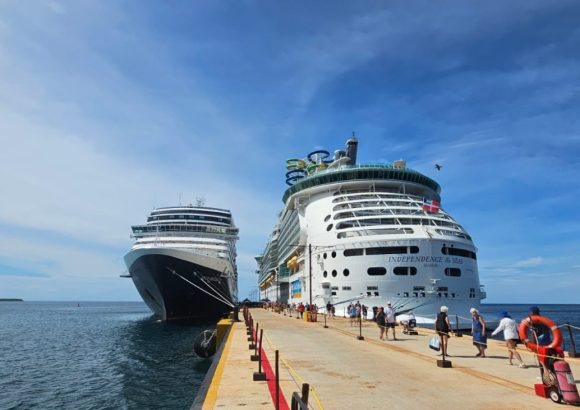
Pedernales, the far southwestern corner of the Dominican Republic, got a busy Monday when not one but two international cruise ships docked at the young Cabo Rojo terminal — Royal Caribbean's Independence of the Seas and Holland America's Nieuw Amsterdam, together offloading roughly 5,771 passengers and 2,264 crew into a province that barely featured on cruise maps a few years ago.
The terminal only opened in January 2024, so the pace of growth is notable. Tourism Minister David Collado framed the double arrival as proof of Pedernales' rising weight in Caribbean cruising, and — more to the point for locals — as a source of income for small businesses: excursion operators, drivers, restaurants and handicraft sellers who now get a regular influx of day visitors.
Cabo Rojo wasn't acting alone that day. Across the country, five ships called at Dominican ports, carrying about 15,503 passengers and 6,421 crew. November alone is expected to bring around 105 cruise calls, spread across the big lines — Royal Caribbean, Carnival, MSC, Norwegian and Holland America among them.
What makes Cabo Rojo interesting for travellers is what it represents: a deliberate government push to spread tourism beyond the well-worn Punta Cana–Puerto Plata axis into the south. Pedernales offers a very different Dominican Republic — arid coastal scenery, the Bahía de las Águilas beach inside Jaragua National Park, and a far quieter, less developed feel than the resort-heavy east. For cruise passengers, calls here tend to mean nature and beach excursions rather than mega-shopping plazas.
If your itinerary includes a Cabo Rojo stop, the standout options are Bahía de las Águilas — often ranked among the country's best beaches — and the park's flamingo habitats and limestone caves. Keep expectations measured on infrastructure: the region is still building out its visitor services, which is precisely the opportunity authorities are trying to sell to investors. For now, that rawness is part of the appeal.