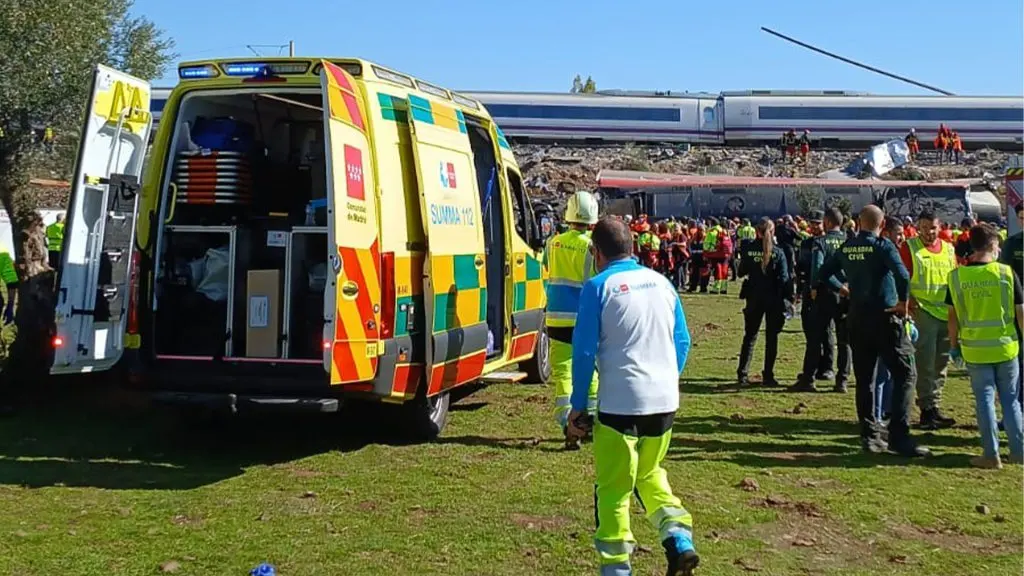
Twelve citizens from nine countries have been confirmed among the 69 people killed when a Renfe high-speed AVE train ran into the rear of a stationary Iryo service near the village of Urda, in Toledo province, last Wednesday. Four of the foreign victims were from the United States, with one each from Argentina, Canada, the Czech Republic, France, Japan, Mexico, Portugal and Tunisia.
Identification work is still ongoing. Of the 69 dead, 66 have now been formally identified — 53 through fingerprints and 13 via DNA analysis — and 54 were Spanish nationals. Three missing-person reports remain open, involving two Australians and another Japanese citizen, and authorities believe the three victims still awaiting formal identification are foreign. Forensic teams are holding off on those confirmations until the families arrive in Spain to identify their relatives in person.
The scale of the operation is considerable: more than 60 professionals are working on identification in Toledo, including forensic doctors from Toledo, Ciudad Real and Cáceres, toxicology specialists running DNA tests, and 27 Guardia Civil criminalistics officers. Psychologists are supporting bereaved families. Around 50 Guardia Civil personnel remain at the crash site, searching the damaged carriages and surrounding ground metre by metre with dogs, drones and judicial police, under a judicially secured perimeter.
Meanwhile, the number of people still in hospital has fallen to 39 — 29 in Castilla-La Mancha, including nine in intensive care, and ten in Madrid and Andalusia. Eighty-one injured people have been discharged, and doctors report patients progressing well.
The crash itself has put Spain's rail safety record under intense scrutiny. Reports suggest an automatic safety system failure stopped trains across a 63-kilometre stretch of line, and a control centre then authorised the AVE to resume its journey while the Iryo train ahead remained stationary. It is Spain's second fatal high-speed collision this year — a January crash in Andalusia killed 46 people on the Madrid–Seville corridor. Prime Minister Pedro Sánchez has promised an investigation and reforms to restore confidence in a network that carried around 45 million passengers last year, many of them tourists. With a general election set for 29 November, rail safety and infrastructure investment have become central political issues.
For travellers, the practical picture is still shifting. High-speed rail remains one of the most popular ways to move between Madrid, Andalusia and the east coast, and services on affected routes may face disruption or changes while the investigation continues. Anyone with a booking in the region should check operator updates before travelling, and allow extra time for journeys through Castilla-La Mancha.