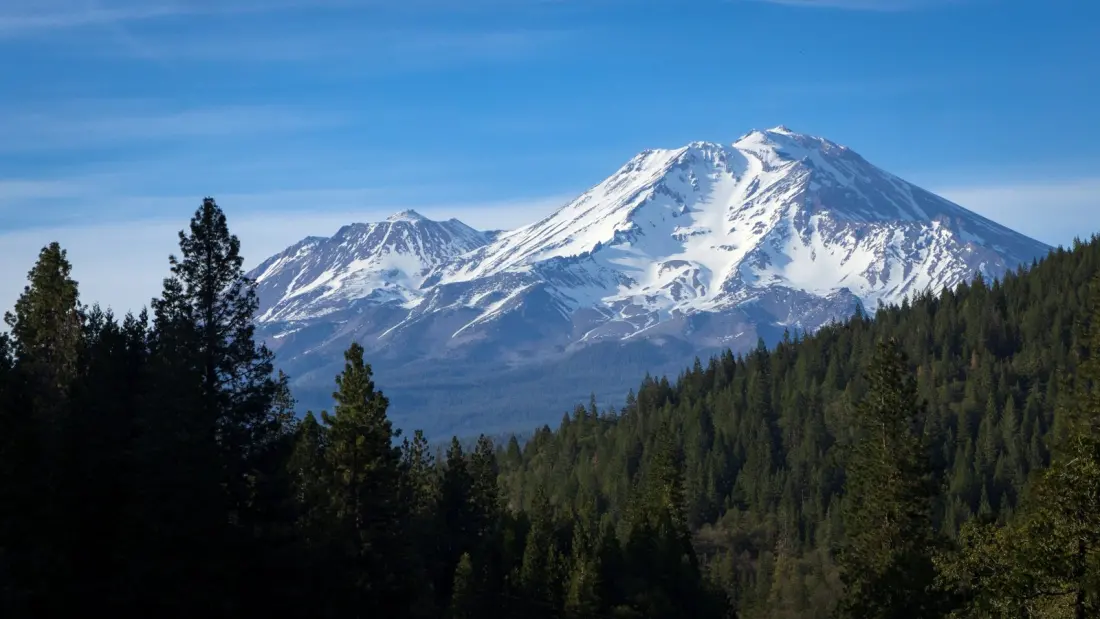
A dayhike that was never supposed to reach the summit ended with a full-scale rescue on Mt. Shasta this week, after two Salt Lake City hikers blew past a posted turnaround time, lost the trail in the dark, and spent nearly a day and a half on the mountain in freezing conditions.
The pair — a 19-year-old man and a 20-year-old woman — set out from the Bunny Flat Trailhead at 4 a.m. on Monday, October 12, planning a non-summit hike alongside a third companion who did intend to reach the top. Their route took them up Avalanche Gulch, the mountain's busiest climbing route, but one that becomes genuinely hazardous in dry conditions: without snow and ice to hold it together, the gulch's terraced scree is loose and crumbly underfoot.
By around 5 p.m., the two had made it as far as Red Banks at 12,800 feet — a full five hours past the turnaround time posted at the trailhead. Temperatures plunged to about 15 degrees, and they weren't carrying the gear to sit out a night at altitude. A distress call went to the Siskiyou County Sheriff's Office at 10:20 p.m., and rescuers advised them to keep descending to stay warm. At 2 a.m. they reported reaching Helen Lake at roughly 10,400 feet. Then their phones died.
The next morning brought a first-light search combining ground crews and CHP air operations. An early sighting near the top turned out to be two unrelated hikers. The breakthrough came through persistence: climbing rangers dropped from Horse Camp — a well-known cabin at 7,880 feet — into Cascade Gulch, a drainage the rescue team considered a low-probability area but worth clearing anyway. Around 4 p.m., searchers heard shouting. Both hikers were found uninjured and walked down with help.
What puzzles rescuers is how they got lost at all. The route from Horse Camp back to Bunny Flat is, in the words of Mt. Shasta climbing ranger program manager Nick Meyers, a "superhighway" — wide, well-marked, and the standard recommended walk for any ability level. The hikers confirmed they'd passed the cabin on the way down; what happened next is still unclear. Their summit-bound companion made it off the mountain safely on his own.
This wasn't an isolated incident. It's one of several rescues on Shasta in a matter of weeks: a hiker airlifted from Horse Camp on September 11 after a high-altitude glissade wrecked his feet, and an early-September team of three who'd planned their summit attempt with AI and needed a long rescue of their own.
The takeaway for anyone eyeing a big mountain dayhike is simple. Turnaround times exist because afternoon conditions — cold, fatigue, fading light — compound fast. Avalanche Gulch in dry fall conditions is a different animal from its snowy spring version, and even a straightforward descent trail can be missed after dark. Start early, carry layers and a headlamp even on a day plan, keep a power bank for your phone, and stick with your group. Shasta will still be there next weekend.