
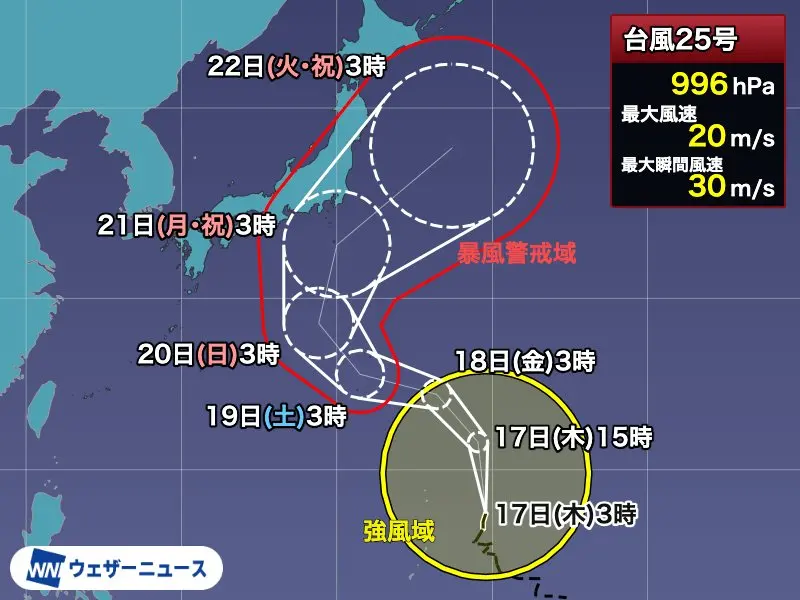
Just as Japan heads into a rare five-day stretch of public holidays, the weather has thrown a wrench in the plans. The Japan Meteorological Agency has confirmed that Typhoon Dujuan — the season's 25th named storm — has formed in the Pacific off the Mariana Islands and is tracking north with Honshu, Japan's largest main island, in its possible path.
As of early Thursday, Dujuan was moving north-northeast at around 20 km/h, with a central atmospheric pressure of 996 hectopascals. Forecasters expect the system to strengthen as it travels, meaning its eventual track and intensity could still shift. The timing is awkward: the holiday run begins this weekend and runs through next week, wrapping up with Autumn Equinox Day on Wednesday. That's a peak window for domestic travel, with millions of Japanese taking short trips, visiting family, or squeezing in a final getaway before autumn properly sets in.
For anyone already in Japan with a trip booked — or flying in for the holiday week — this is a story worth watching closely. Typhoons at this time of year are not unusual for Japan, but a direct approach to Honshu during a mass-travel period raises the odds of flight cancellations, shinkansen delays, ferry suspensions and temporary closures at attractions, particularly along the Pacific coast. Trains in Japan generally run well in heavy weather but will slow or stop when wind and rain thresholds are hit, and airlines often waive change fees once a typhoon approach is confirmed.
The practical advice is straightforward: keep an eye on JMA updates and your carrier's alerts over the coming days, as the forecast will firm up well before landfall. If your plans are flexible, building in a buffer day at either end of the holiday week is a sensible move. Travellers in Tokyo, Osaka, Nagoya and surrounding areas should also expect crowded stations earlier or later than usual as people adjust their departure times around the weather. Indoor backups — museums, onsen towns, city food neighbourhoods — are a good hedge if outdoor itineraries like hiking or coastal day trips need to be swapped.
There's no need to cancel anything yet. A projected approach is not a guaranteed hit, and typhoons frequently weaken or veer before reaching the main islands. But with a five-day holiday concentrating travellers on the same routes and dates, even a near miss can cause knock-on congestion as everyone rebooks at once. Check before you travel, not after.