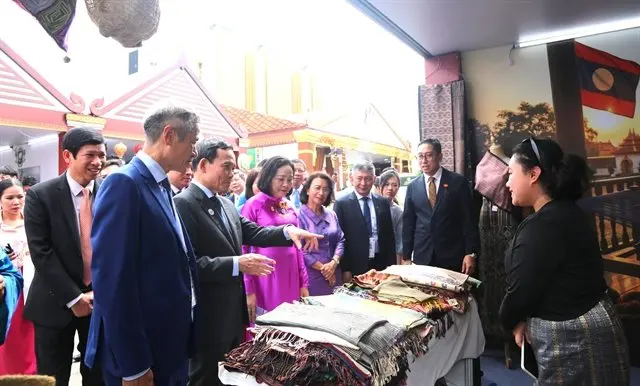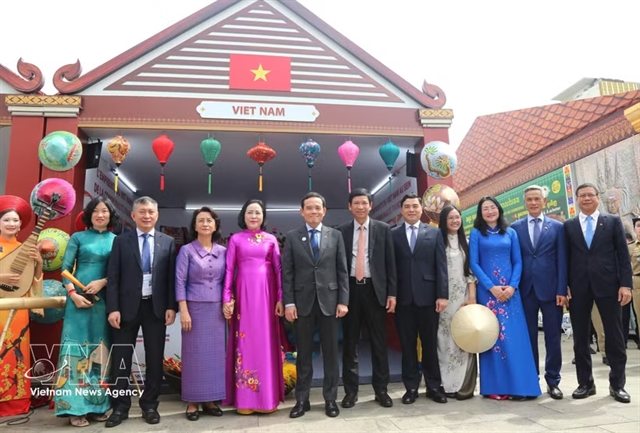
Phnom Penh hosted the 20th Francophonie Summit from November 14-16, and alongside the formal meetings, the Cambodian capital set up a Village Francophone — a cluster of cultural exhibition spaces where participating countries showed off what makes them distinctive. Việt Nam sent a high-ranking delegation, led by Politburo member and HCM City Party Committee Secretary Trần Lưu Quang, to tour the spaces on November 15, welcomed by Cambodia's Minister of Women's Affairs Ing Kantha Phavi.
The Vietnamese pavilion leaned heavily on craft traditions that travellers will recognise if they've spent time in the country's workshops and old quarters. On display were traditional musical instruments, ethnic costumes, rattan and bamboo weaving, and lacquerware made with an unusual range of materials — bamboo, wood, coal, eggshell, gold and silver. Ceramics came from two famous sources: Bát Tràng, the centuries-old pottery village outside Hanoi, and Chăm ceramics from central Vietnam. Đông Hồ folk paintings also featured, a woodblock printing tradition that was added to UNESCO's Intangible Cultural Heritage in Need of Urgent Safeguarding list — a reminder that these crafts are living heritage, not museum pieces.
The Vietnamese delegation also toured the spaces of host Cambodia, Laos, the Wallonia-Brussels delegation and the International Organisation of La Francophonie itself, treating the village as a networking exercise as much as an exhibition. The stated aim was cultural diplomacy: positioning Việt Nam as an active, responsible member of the Francophone community and using craft, music and performance to open doors for wider cooperation.
For travellers, the interesting bit is what the story says about Phnom Penh and the wider region. The Francophonie Summit drew delegations from across the French-speaking world to a city that is steadily building a profile as a regional hub — a short flight from both Hồ Chí Minh City and Hanoi, and increasingly easy to combine with Vietnam on a single Southeast Asia loop. Cambodia, Laos and Vietnam all share Francophone ties alongside their own deep craft cultures, so the themes on display in Phnom Penh — lacquer, ceramics, weaving, folk printing — are ones you can follow physically across borders, from Bát Tràng's kilns to Cambodian silk-weaving villages.
The summit has now wrapped, but the cultural pull remains: if the Village Francophone showcased anything, it's that the Mekong region's craft traditions are the region's best ambassadors — and the best reason to linger in a place rather than pass through it.