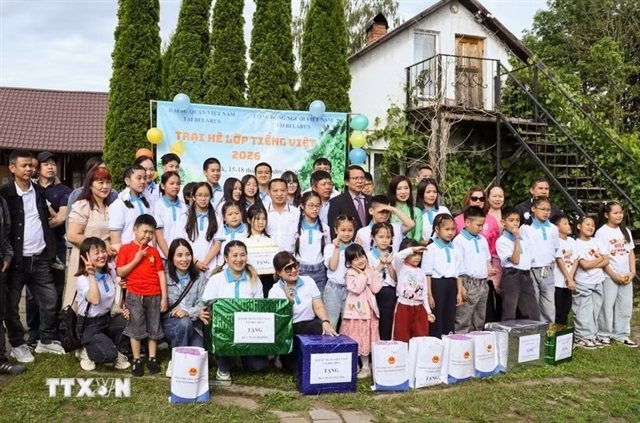
Sunday afternoon at the Minsk State Palace of Children and Youth looked a little different from usual. On November 9, children of Vietnam's diaspora in Belarus gathered there to mark the start of the 2026–2027 school year of Vietnamese language classes — an event that doubled as a mini festival of Vietnamese culture in the middle of Eastern Europe.
The ceremony was organised by the Vietnamese Embassy together with the association of Vietnamese people in Belarus, and it came with plenty more than a first-day roll call. There were dance and singing performances, poetry recitals, and an áo dài display featuring students and parents in Vietnam's traditional long dress. A photo exhibition introducing Vietnam and its people ran alongside, timed to celebrate Vietnam Culture Day, which falls on November 24.
Ambassador Nguyễn Văn Trung used the occasion to underline why the classes matter beyond homework and vocabulary. Language and culture, he argued, are inseparable — and keeping the mother tongue alive abroad is how families hold on to their roots, traditions and values. He also framed the schools as a two-way bridge: they give children of Vietnamese families pride in their heritage, while introducing Vietnamese culture to Belarusian friends and classmates.
Trương Công Đạo, who chairs the Vietnamese association in Belarus, praised the students' enthusiasm and encouraged them to keep working hard and stay connected with their parents' homeland.
So why should a traveller care? Because these community-run cultural institutions are often the best window into a place you'd otherwise miss. Vietnam has a surprisingly deep footprint in Eastern Europe — a legacy of Cold War-era student exchanges and labour programmes — and Belarus is one of the countries where that history is still visible, from Vietnamese cafés and markets in Minsk to events like this one. If you find yourself in the Belarusian capital around late November, Vietnam Culture Day events are a genuine, local-scale way to encounter the community rather than just pass through it.
The broader takeaway is a familiar one for anyone interested in diaspora travel: culture travels with people. A Sunday language school in Minsk, complete with áo dài and poetry, is doing the same quiet work as Chinatowns, Little Odessas and Little Italys everywhere — keeping a homeland present in a place thousands of kilometres away.