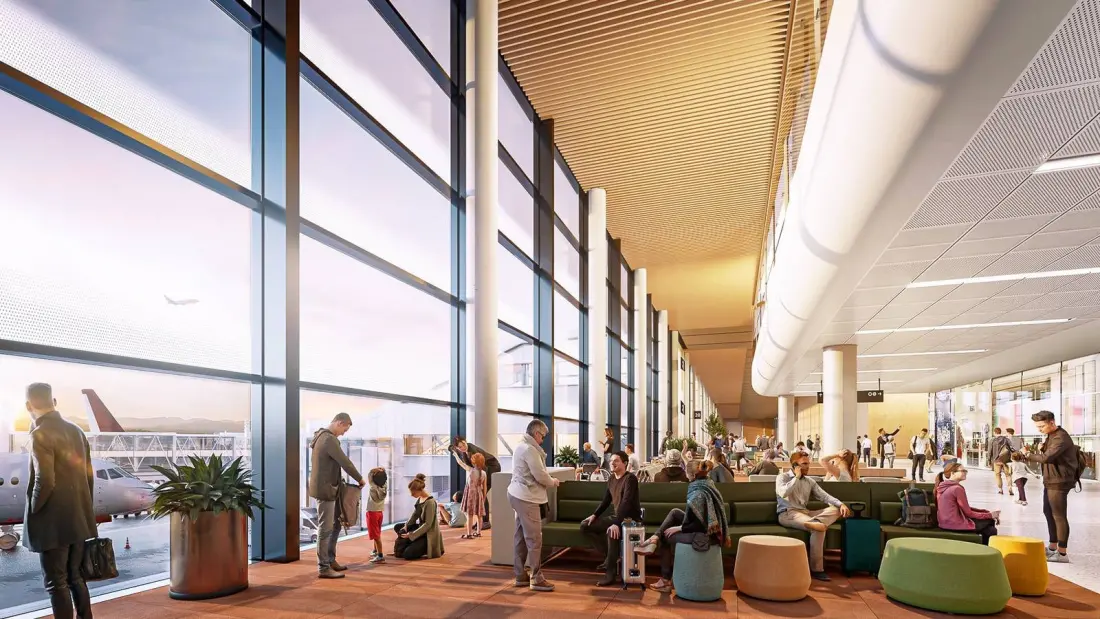
Australia's first brand-new major airport in over 50 years is about to start flying. Western Sydney International (WSI), at Badgerys Creek roughly 44 km west of the city centre, opens in late October and brings something Sydney Kingsford Smith has never been able to offer: 24-hour operations, with no curfew limiting when planes can take off and land.
What makes the project unusual is how it was built. Rather than the old "build it and they will come" approach, the airport signed a memorandum of understanding with Qantas and Virgin Australia back in 2019, letting the airlines shape everything from the terminal and boarding gates to baggage handling, security tech, parking, ride-share access and even sustainability measures. Qantas went further than anyone. At the 50% construction milestone in 2023, it committed to basing 15 narrowbody aircraft on site — ten Jetstar and five Qantas — a deal the airport says will generate over 25,000 flights a year, serve around four million passengers, and support roughly 700 jobs. Qantas Freight also came aboard as the first courier signed up.
The model has precedent: Munich's Terminal 2 Satellite, a joint venture between the airport and Lufthansa costing about €900 million, has handled around 93 million passengers in its first decade and earned a five-star Skytrax rating.
International carriers are joining too, just without basing planes there. Air New Zealand starts three return flights a week from Auckland when the airport opens, and Singapore Airlines will fly daily to Changi from November, on top of its four daily services at Kingsford Smith.
Don't expect a mega-hub on day one. The opening phase caps capacity at ten million passengers a year — well under the 42.5 million that passed through Kingsford Smith in 2025 — with a single 3.7 km runway and one terminal handling both domestic and international flights. Jetstar launches first in October with two daily Melbourne services plus flights to the Gold Coast and Brisbane; Qantas-branded aircraft follow in early 2026.
The long game is where it gets interesting. The 1,780-hectare site leaves room for decades of growth: the terminal will eventually stretch across the midfield into a single building with four interconnected processors handling 37 million passengers, a second parallel runway is pencilled in for the 2050s, and by 2063 the airport projects capacity of about 82 million passengers annually. The stated ambition is nothing less than becoming Australia's largest airport.
For travellers, the practical win is simple: a second Sydney airport means more competition, more flight choices, 24-hour schedules and — if Jetstar's low-fare track record holds — cheaper fares to Melbourne, Brisbane and the Gold Coast, plus direct links to Auckland and Singapore from Sydney's west. Anyone living west of the CBD will also finally have an airport within easier reach than the long haul to Botany Bay.