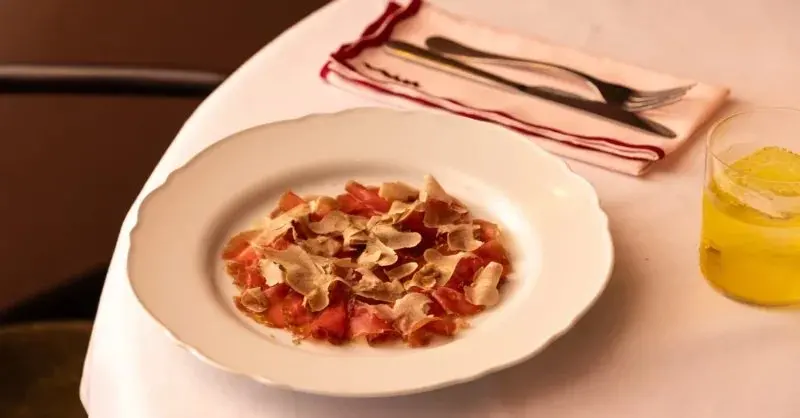
Every autumn, a short window opens for one of fine dining's most expensive ingredients. White truffles are hunted from October to December, with November the peak month for aroma and flavour — and because they grow wild and are found only with trained dogs, they command eye-watering prices, anywhere from $4,000 to $9,300 per pound in the US, usually sold by the ounce or gram.
Everyone assumes Alba in Piedmont is the only place that matters. Chefs push back on that. Alba is a market town, not a quality certificate — plenty of truffles sold under its name come from elsewhere, and good specimens are hunted across Piedmont, in Tuscany's Crete Senesi around San Giovanni d'Asso, and around San Miniato. For value, chef Karl O'Dell points to Molise and the Umbrian hills, where the same species sells for a fraction of the price. Others rate Istrian and Hungarian forests.
When you're face to face with a truffle, your nose decides. A fresh one should smell powerful, clean and intense — never muddy or ammonia-tinged. It should feel firm and heavy for its size, with no pinprick holes (a sign of fly larvae) and no soil jammed in its crevices. Skip the giant showpiece: a smaller, fresher truffle beats a big stale one, and you should buy for the dinner you're actually cooking, since a large specimen fades fast.
Sourcing is the hard part. Cold displays suppress the aroma, so insist on smelling a truffle at room temperature in your palm for a good twenty seconds — if a seller won't allow that, walk away. Better yet, find a merchant or deli who can tell you exactly where and when it was harvested. In Italy, buy straight from a tartufaio, or truffle hunter, for full traceability. Stateside, New York chefs point to Eataly and specialist truffle shops. One underrated route: ask a restaurant known for its truffle dishes — some kitchens, like London's Novikov, sell them to regular guests.
Once home, eat it as soon as you can. If you must wait, wrap it in absorbent paper, change the paper daily, and keep it in an airtight jar in the fridge. Resist the classic rice trick — rice draws out too much moisture and dries the truffle out. Don't wash it until just before serving (a gentle brush only, never a soak), don't freeze it, and aim to use it within three to five days. Aroma is what you're paying for, and it's the first thing to go.
For travellers, this doubles as a reason to plan an autumn trip to Piedmont or Tuscany, when truffle fairs and local hunters make the season tangible — and let you taste the real thing at the source before it disappears until next October.