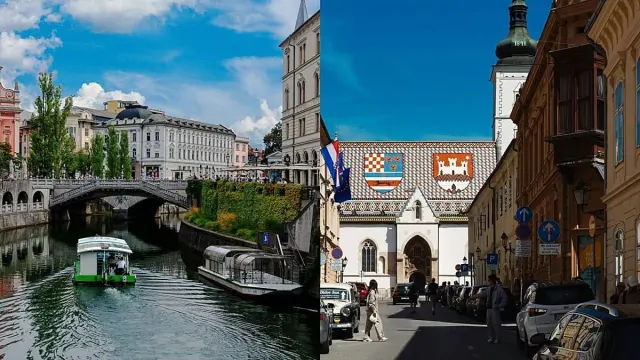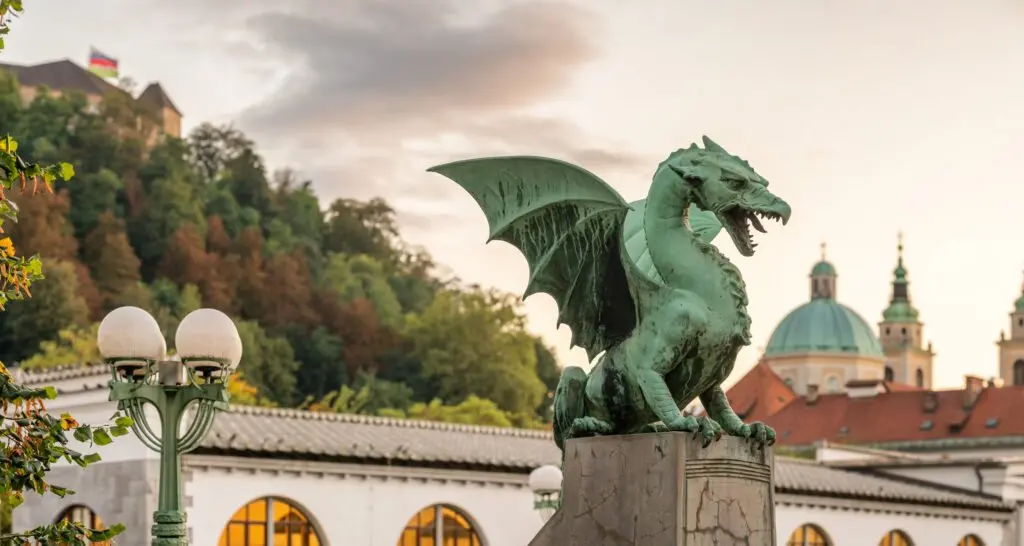
Four copper dragons, wings spread and claws out, watch over the Ljubljanica River from the corners of Ljubljana's Dragon Bridge. They look like decoration. They're anything but — the dragon is the official symbol of Slovenia's capital, and the story behind it goes back thousands of years.
The legend credits Jason and the Argonauts with founding the city. After snagging the Golden Fleece, the Greek heroes supposedly took a navigational detour into the Danube delta instead of heading across the Black Sea. They rowed inland along the Danube, then the Sava, and finally reached the Ljubljanica — where they stopped for the winter and ran into something with a fiery temper lurking in the fog. After a long fight, Jason's crew killed the dragon, and the creature has been part of the city's identity ever since.
There's even a rational explanation for the fire: Ljubljana's surrounding moors sit on peat, which can spontaneously combust. Locals saw flames and smoke rising from the marshland for centuries and drew the obvious (to them) conclusion that something monstrous lived down there. Ljubljana guide Mojca Šoštarko, who leads dragon-themed walks through the Old Town, puts it with a wink: people saw the fire, but she wouldn't swear they didn't see a dragon too.
Once you know the story, you spot dragons everywhere. There's one on the city's coat of arms above the Town Hall, dragon figurines filling shop windows, and a whole store — the Dragon Shop, fittingly — selling dragon mugs, magnets, T-shirts and plush toys. The Pivovarna Union brewery prints golden dragons on its beer bottles, the city's buses carry the emblem, and sports teams play under the same winged banner. Ljubljana Tourism even fields two mascots: Ljubo, a friendly-faced dragon who stars on souvenirs, and Zmajček ("Little Dragon"), who turns up at events around town.
What makes this more than a marketing exercise, according to Simeon Gönc of Ljubljana Tourism, is how the symbol's meaning has shifted. A creature that began as a fearsome monster from a founding myth has softened over the centuries into a guardian — a stand-in for courage, strength, wisdom and resilience. In other words, the dragon became a mirror of how the city sees itself.
For visitors, the payoff is a compact capital where the sightseeing has a through-line. Cross the Dragon Bridge, walk the riverside into the Old Town, check out the Town Hall emblem, then duck into the Dragon Shop or grab a Union beer and toast the beast. Ljubljana is small enough that you can trace the whole dragon trail in a morning, ideally with a local guide who can tell the Argonaut version of events with the right amount of drama. It's a rare case of a city's tourist souvenirs, civic identity and ancient folklore all pointing at the same scaly thing.