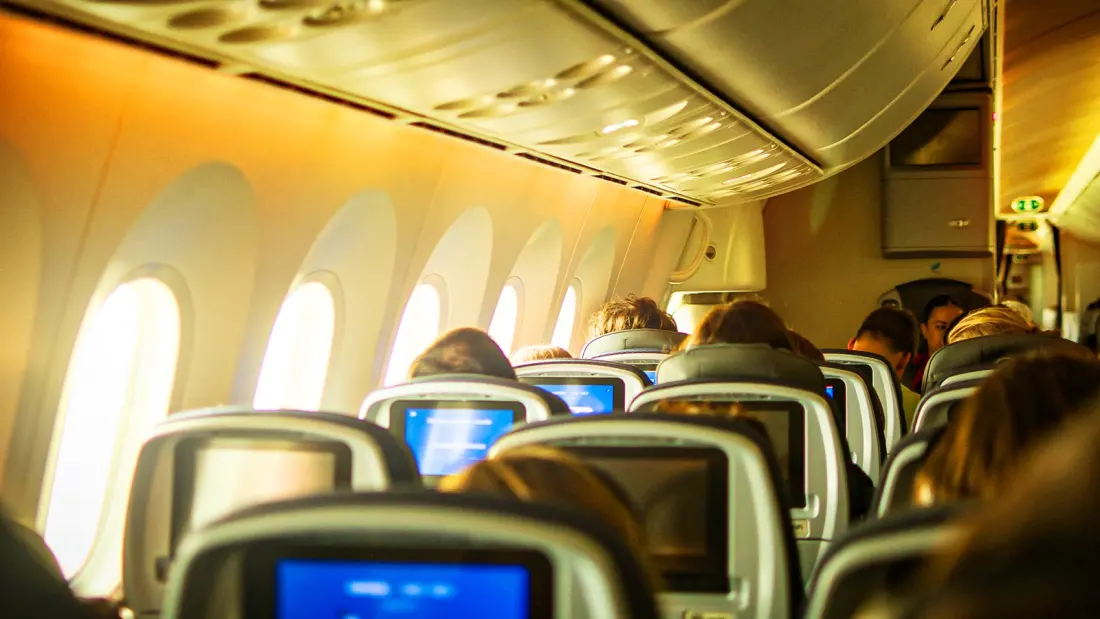
Arriving from a ten-hour flight feeling like you've been wrung out isn't just jet lag. A chunk of that misery comes from the air itself — and the Boeing 787 Dreamliner changed it in ways most passengers never notice but definitely feel.
For decades, airliners have pressurised their cabins to an altitude of up to 8,000 feet. That number was never chosen for passenger comfort — it was a legal ceiling set by what an aluminium fuselage could endure. Every flight flexes the hull through a full pressure cycle, and metal accumulates fatigue damage over tens of thousands of cycles in a 25- to 30-year life. Pressurise harder and the maintenance bills compound.
Boeing sidestepped that constraint by building the 787 from composite materials. The stronger carbon-fibre fuselage tolerates the extra pressure differential, so the cabin sits at 6,000 feet instead — a roughly 7.5% higher cabin pressure that feels like a 25% drop in altitude. Research in the New England Journal of Medicine put numbers on why this matters: volunteers in a hypobaric chamber simulating a 20-hour flight felt steadily worse as cabin altitude rose, with blood oxygen falling by up to about 4.4 percentage points at the 8,000-foot end. Not dangerous for healthy people, but a background deficit that feeds the headaches and flatness long-haul flyers know well. The Airbus A350 and Boeing 777X, both composite, match the 6,000-foot figure — while the aluminium-framed A330neo still sits at 7,000 to 8,000 feet despite modern everything else.
Humidity tells a similar story. Conventional cabins run a parched 4 to 7% relative humidity in cruise; the 787 holds somewhere between 15 and 25%, roughly two to three times wetter. Moisture corrodes aluminium, so this was only possible because the structure isn't metal. Boeing even worked with Denmark Technical University to confirm that humidity alone wouldn't fix dry-air complaints, then paired the higher moisture with extra filtration for odours and contaminants.
The boldest change is where the air comes from. Nearly all airliners tap engine bleed air for pressurisation, a pathway linked to occasional 'fume events' — the FAA-funded research puts them at roughly one in 5,000 flights. The 787 scrapped bleed air entirely, pulling fresh air through two dedicated inlets with electrically driven compressors instead. With more than 1,300 aircraft delivered and around half a million passengers flown daily, the concept has a solid track record, though Airbus has stuck with conventional bleed air even on the composite A350.
For travellers, the practical takeaway is simple: when booking a long-haul route, the aircraft type matters. A 787 or A350 will feel noticeably fresher and less dehydrating than an older airframe on the same route — worth checking before you lock in that 12-hour flight.