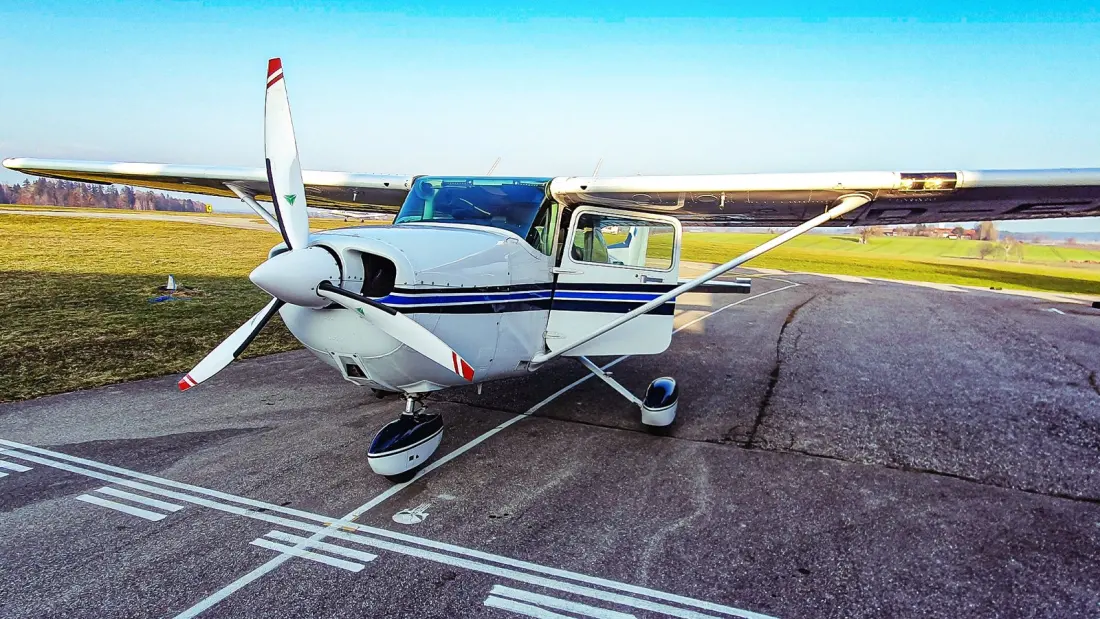
Seventy years after it first flew in 1955, the Cessna 172 Skyhawk remains the most-produced aircraft in history, with around 45,000 delivered worldwide according to Textron, Cessna's parent company. That total comfortably beats the closest contenders — the Soviet Ilyushin Il-2 Sturmovik (36,183 built) and Germany's wartime Messerschmitt Bf 109 (34,852) — both of which were military aircraft, while the Skyhawk is a humble four-seater used for flying lessons and weekend trips.
The design began as a nosewheel version of Cessna's earlier Model 170, developed quickly after sales of the taildragger 170B started to slip. It launched into a postwar boom in personal flying in the United States, and its high-wing layout gave pilots and passengers something rare in light aircraft of the era: an unobstructed view of the ground below. That same feature makes it a favourite for scenic flights today, whether over coastlines, canyons or farmland.
What kept the Skyhawk alive through seven decades was steady evolution rather than reinvention. The 1960s brought a swept tail, streamlined cowling, electric flaps and the Lycoming O-320 engine; the 1970s and 1980s added tougher landing gear and more powerful variants; and from the 1990s onward came the Garmin G1000 glass cockpit, GPS and modern autopilots. The current 172S cruises at up to 124 knots (230 km/h), seats four, has a range of 640 nautical miles and a service ceiling of 14,000 feet — modest numbers, but perfectly suited to training and short hops.
The aircraft's biggest role is as the world's flying classroom. Airline pilot numbers are set to grow sharply — Boeing forecasts 660,000 new pilots needed by 2044 — and in the US, student pilot certificates jumped from 128,501 in 2016 to 370,286 by the end of 2025. Most of those learners will log their first hours in a Skyhawk, whose stable slow flight, forgiving handling and simple fixed tricycle gear make it unusually kind to beginners. A US Private Pilot Certificate typically requires 50 to 70 flight hours, taking three to twelve months depending on schedule and weather.
For travellers, the practical appeal is straightforward: the Skyhawk is the aircraft you are most likely to ride in for a trial flying lesson or sightseeing flight almost anywhere in the world, from flight schools at small regional airfields to flying clubs near major holiday destinations. Prices reflect its enduring popularity — a new 172 costs roughly $450,000 to $550,000, with used models from $300,000. Cessna supports it with a parts inventory of 140,000 items and a 99% same-day shipping rate on in-stock parts, which is why the type is so easy to find at airfields globally.
Built at Textron's plant in Independence, Kansas, alongside the 182 Skylane and 206 Stationair, the Skyhawk shows no sign of disappearing. For anyone curious about learning to fly — or simply wanting a window seat with the best view on offer — the 172 remains the natural starting point.