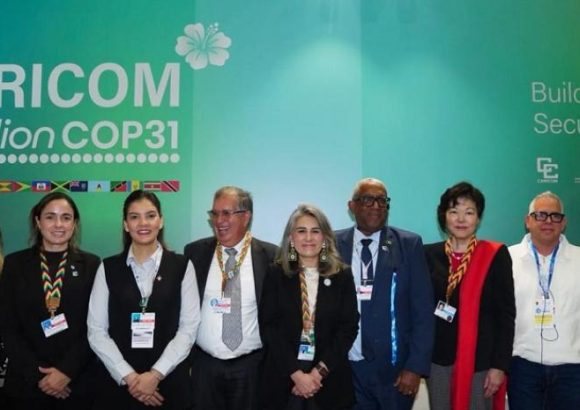
Sargassum season has become one of the Caribbean's biggest travel headaches, and there's finally a serious, coordinated push to do something about it. At COP31, the Development Bank of Latin America and the Caribbean (CAF) and the Global Environment Facility (GEF) unveiled SargMarine, a regional project backed by a US$10 million GEF grant, with an additional US$67.3 million in planned co-financing. Mexico and France supported the launch, CAF will implement the project, the Organization of American States acts as executing agency, and the Inter-American Institute for Global Change Research joins as a technical partner.
The numbers behind the problem are stark. According to the UN Environment Programme, 37.5 million tons of Sargassum were floating in the Atlantic in May 2025 — the largest volume recorded since monitoring began in 2011. When these mats wash ashore they choke beaches, damage coastal ecosystems, hurt fishing, and pose health and sanitation issues for communities that depend on tourism.
SargMarine's approach rests on three pillars: sharing information across borders, improving the ability to forecast and manage seaweed arrivals, and developing alternative uses for the algae that can feed local economies. That last part matters — officials see potential in a circular-economy model where harvested Sargassum becomes a raw material rather than pure waste.
The launch doubled as a airing of national frustrations. Colombia's environment minister Fabio Arjona Hincapié argued that local fixes alone won't cut it against a phenomenon that ignores maritime borders. Jamaica's climate envoy Matthew Samuda said his country's priority is better monitoring and forecasting — knowing when and where the seaweed will land so authorities can target protection and plan harvesting. The Dominican Republic's Ana Emilia Pimentel pushed for the human angle, insisting community needs and economic impacts be part of any response. Panama's ambassador Karina Arias summed up the ambition: coordinated work between governments, scientists, agencies and the private sector, so solutions stop being fragmented.
Why should holidaymakers care? Because Sargassum is the difference between a postcard beach and a brown, smelly shoreline, especially in the summer months on islands like Punta Cana, Mexico's Riviera Maya, and parts of the Lesser Antilles. If forecasting improves, hotels and local authorities will be able to warn guests, deploy barriers or cleaning crews faster, and protect the stretches of coast that matter most to visitors. The project has final approval and is ready for action on the ground, per GEF's Chizuru Aoki — so results will take time, but the direction of travel is encouraging. In the meantime, travellers heading to the Caribbean between roughly April and October should check recent beach conditions for their specific stretch of coast before booking, since Sargassum impact varies wildly from one bay to the next.
Story reported by Dominican Today.