A strange-sounding breakfast is taking over Vietnamese food groups online: a buttery French croissant, split open and packed with gio cha — the country's beloved steamed pork roll and fried pork paste. Netizens have given the mashup a nickname that says it all: "King Hung shaking hands with Emperor Napoleon," a nod to the legendary founder of Vietnam meeting France's most iconic pastry.
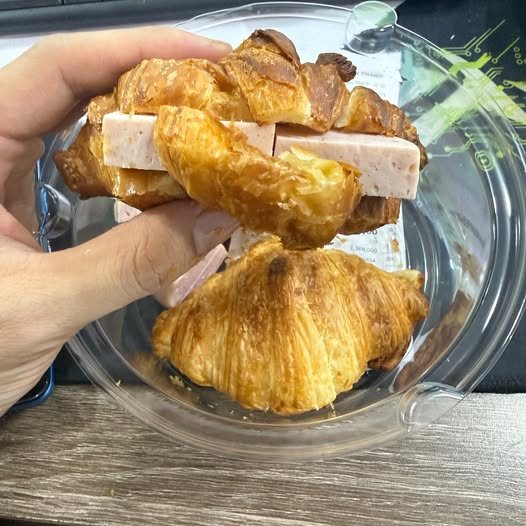
The concept is basically banh mi's posh cousin. Instead of a baguette, the filling goes into a croissant baked to a glossy amber-gold with distinct flaky layers and an airy, honeycomb crumb inside. Slices of cha lua — pale pink pork roll with a smooth cross-section full of tiny air pockets, a sign of proper springy texture — get tucked into the pastry. Some versions add fried cha with a golden-brown crust and a plump, pinkish centre. You can go with one, the other, or both in a single croissant.
How you slice the pork is apparently a matter of personal philosophy. Thick slabs give you a hearty, chewy mouthful; paper-thin layers melt into the flaky pastry so the subtle savouriness runs through every bite. Viral videos show people cutting straight from a whole roll, thick and thin slices tumbling onto the board — and thousands of likes piling up underneath.
What makes the dish work is the supporting cast, lifted straight from the classic banh mi playbook: a smear of pâté inside, a dip into rich egg butter sauce (sốt đậu trứng), pork floss (chà bông) sprinkled on top, plus fresh cilantro, pickled carrot and daikon to cut the richness, green chilli for heat, and a little dish of chilli salt for purists. Sour, rich, savoury and spicy all at once — inside a laminated dough shell.
There's even a tidy culinary footnote: "Napoleon" is an alternate name for mille-feuille, France's thousand-layer pastry, and croissants belong to the same laminated dough family. So the French-Vietnamese handshake is less absurd than it first sounds. France left a deep culinary imprint on Vietnam during the colonial era — that's exactly how banh mi came to exist in the first place — so this new creation is really just the next chapter of a 100-year-old fusion story.
Few people have delivered a firm verdict on how it actually tastes, but the photos alone have been enough to inspire friends to plan weekend hunts for the dish. For travellers heading to Hanoi or Ho Chi Minh City, it's a reminder that Vietnam's street-food scene never sits still — and that the banh mi you know is just one expression of a much broader tradition of Franco-Vietnamese baking. Expect the croissant-gio cha to start appearing at bakeries and social-media-driven cafes near you; it's an easy, cheap breakfast to try alongside your morning cà phê sữa đá, and a genuinely fun thing to photograph.