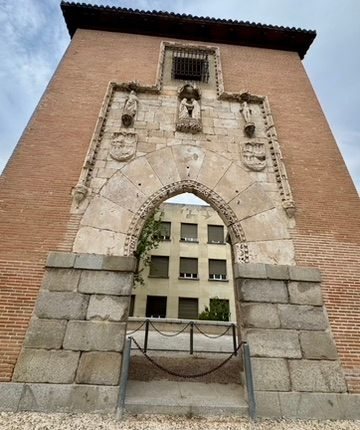
Tucked among the modern buildings of Madrid's Ciudad Universitaria is a piece of the city that really shouldn't be there: an ornate flamboyant Gothic portal, all pointed arches, carved canopies and heraldic shields, standing free of any building. This is the Puerta del Hospital de la Latina, and its odd location is the result of a story spanning five centuries.
The doorway was once the entrance to the Hospital de la Concepción de Nuestra Señora, founded in 1499 by Beatriz Galindo and her husband Francisco Ramírez. Galindo was one of the most remarkable women of her era — a scholar of Latin who tutored the children of Isabella I of Castile, earning the nickname 'La Latina'. That nickname stuck to the hospital, and later to the whole neighbourhood that still carries it today.
The hospital itself stood at the corner of Calle de Toledo and Plaza de la Cebada, in the heart of the La Latina district. Its design, attributed to a master craftsman named Hazan, blended Gothic and Mudéjar influences, and the entrance featured sculptures of Saints Joachim and Anne embracing before the Golden Gate. The institution lasted four centuries, even doubling as a military hospital during the Peninsular War.
Its end came not through war but through urban planning. In 1904, the hospital and the adjacent Convent of the Concepción Francisca were demolished to widen Calle de Toledo. Nearly everything was lost — except the entrance. The dismantled portal spent decades in municipal storage before architect Fernando Chueca Goitia arranged its rescue. In the late 1950s it was rebuilt beside the School of Architecture, a few kilometres from where it began, with a new brick structure and tiled roof added behind it.
For travellers, this makes a wonderfully strange detour. You reach it via the Ciudad Universitaria metro stop on line 6, followed by about a 15-minute walk. It sits quietly among trees while architecture students pass by, a fragment of medieval Madrid enjoying a second life far from the crowded streets of its old neighbourhood.
It pairs naturally with a visit to La Latina itself, where you can stand at the original corner and trace the story backwards. Few cities can claim a front door that outlived its building, its street and its century — Madrid has one, and most visitors walk right past it.