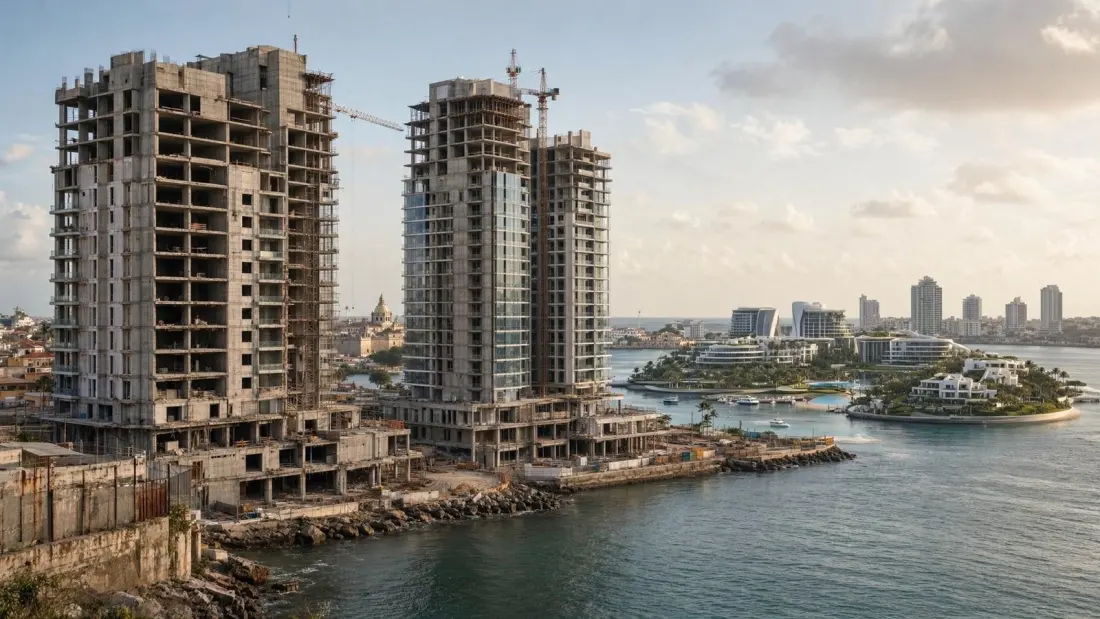
A decade ago, developers pitched Volare Mare as a mini-Dubai on Colombia's Caribbean coast: a 176-hectare artificial island near Cartagena with private beaches, navigable lakes, a golf course and gleaming white towers reflected in "14 hectares of water mirrors." Today, according to El Tiempo, buyers have a handful of apartment towers, unfinished roads and a lot of questions.
The project launched around 2015 in Punta Canoa, about four kilometres along the Cartagena-Barranquilla road, on land reportedly negotiated for roughly US$13.9 million. The sales machine was impressive: scale models toured Bogotá shopping centres and trade fairs like Titan, Gran Estación and Corferias, renderings promised a tourist canal, spa, gym and even electric bowling lanes, and apartments were advertised from about US$86,000 in 2018.
What convinced hundreds of families was partly the money demand: the builder, R.A. Constructores, required at least 40% of the price upfront. One buyer told Portafolio she paid an initial instalment of US$37,126 — before the towers ever rose past bare concrete. Delivery dates slipped, construction stalled for more than three years, and by 2023 around 600 buyers had lodged complaints.
A new developer, Altium Desarrollo Inmobiliario, restarted stages one and two in November 2022, but the numbers tell a bleak story. Colombia's latest trust report shows only about 10 of the 176 hectares hold the single completed stage; roughly 120 of 576 planned apartments have been delivered, and just 113 units (19.6%) had signed deeds by January 2026. Stages three to five failed outright, which legally obliges the builder to refund investors. A late-2023 licence change carved the land into seven lots and pivoted to a new scheme, Punta Coral — while the 140-member Azobolare owners' association lost the pools, golf course and lake entirely, and only 20 to 30 families remain on a site without formal water or sewage networks.
There is a sliver of hope. In 2026, investors from Antioquia bought the project's debt, the trust withdrew its liquidation request, and in July one buyer recovered his full investment through a settlement. Whether the rest of the families get rescued — or see the island buried under Punta Coral — is still unknown.
Why should a traveller care? Because this is the textbook case of buying property sobre planos — off-plan — abroad, whether it's a holiday apartment or an retirement bolt-hole on the Caribbean. Committing 40% or more before a single brick goes up leaves you exposed to builder insolvency, licence changes and a resort that never materialises. Cartagena itself remains a fantastic destination — walled old town, Caribbean islands, great food — but anyone tempted by glossy coastal development renderings should demand escrow protections, check the trust structure, and treat promotional videos as marketing, not promises.