Lie-flat seats used to be a widebody privilege. That changed on June 15, 2014, when JetBlue put flat beds into an Airbus A321 and launched Mint between New York JFK and Los Angeles — undercutting the recliner-seat premium cabins American, Delta and United were selling on the same route. A decade on, the A321neo and its long-range variants carry proper lie-flat business class on both US transcontinental runs and across the Atlantic.
JetBlue's A321neo Mint cabin is the benchmark. Sixteen seats in a 1-1 layout, every one a private suite with a closing door and direct aisle access, fitted with Thompson Aero VantageSOLO seats and Tuft & Needle foam bedding. The two Mint Studios at the front add a 22-inch TV — the largest on any US airline — a mirrored vanity, a guest seat, and a bed The Points Guy measured at just over 82 inches. Watch the aircraft type when booking: JetBlue's older A321 Classic with Mint has only four door suites, with the rest in 2-2 rows. The same seat product also flies to Europe: JetBlue runs twice-daily JFK–Heathrow for winter 2026-27, plus JFK–Paris and Boston services to both cities, with Amsterdam, Dublin, Edinburgh, Madrid and Milan rounding out what is now the largest A321LR transatlantic network of any airline.
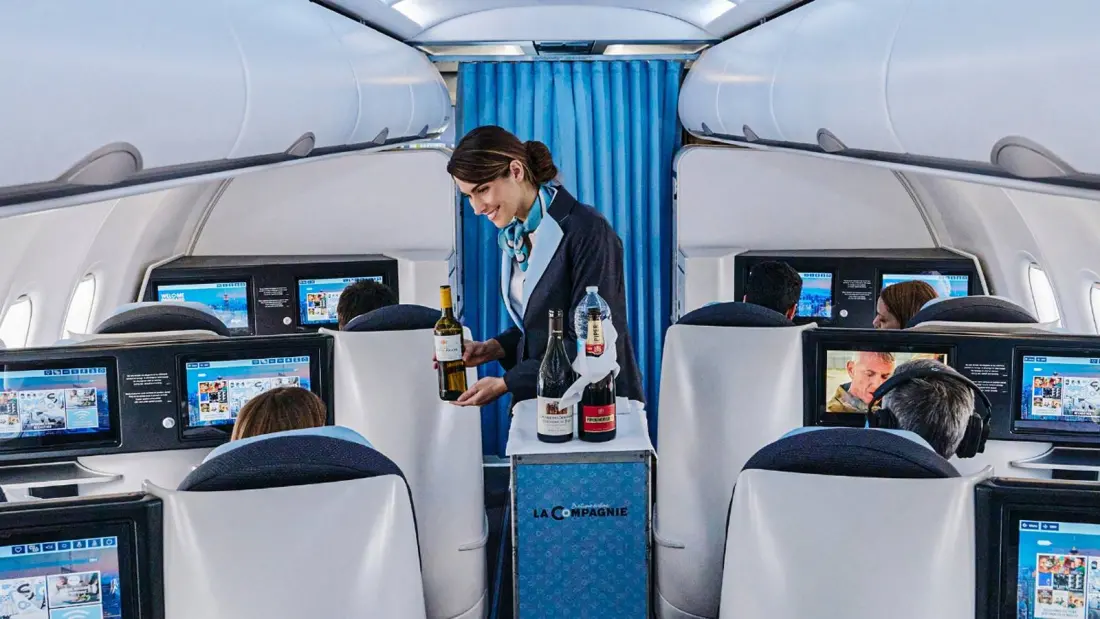
La Compagnie took a different route entirely: an all-business-class A321neo with 76 lie-flat seats in a 2-2 layout and nothing behind them, flying Newark to Paris Orly as its core route, with Milan and seasonal Nice. Because there's no economy cabin to subsidise and no connecting network, fares are among the most consistently affordable ways to cross the Atlantic in a flat bed. The trade-off is aisle access — not every passenger has it.
TAP Air Portugal uses its A321LRs from Lisbon to the US and Canada, plus routes to Africa and Brazil. The Thompson Vantage seat lies flat but sits in a staggered layout rather than JetBlue's 1-1. Lisbon's position as the westernmost major European hub shortens the crossing and makes secondary North American cities viable without a widebody. SAS runs the smallest fleet of the lot — just three A321LRs with the same Thompson Vantage seat — on select Scandinavia–North America routes, so whether you get a narrowbody or a widebody depends on the route and the day.
Why does this matter to travellers? Smaller aircraft mean smaller business cabins — 24 seats on a JetBlue A321LR rather than 60 on a widebody — which changes both availability and award space, for better and worse. It also means routes that never had nonstop service now do, from Boston to Edinburgh to Newark–Orly, often at fares widebody competitors can't match. If a flat bed on a five-hour transcon or an affordable one across the Atlantic sounds good, check which aircraft is operating your flight before you book.
Original reporting: Simple Flying