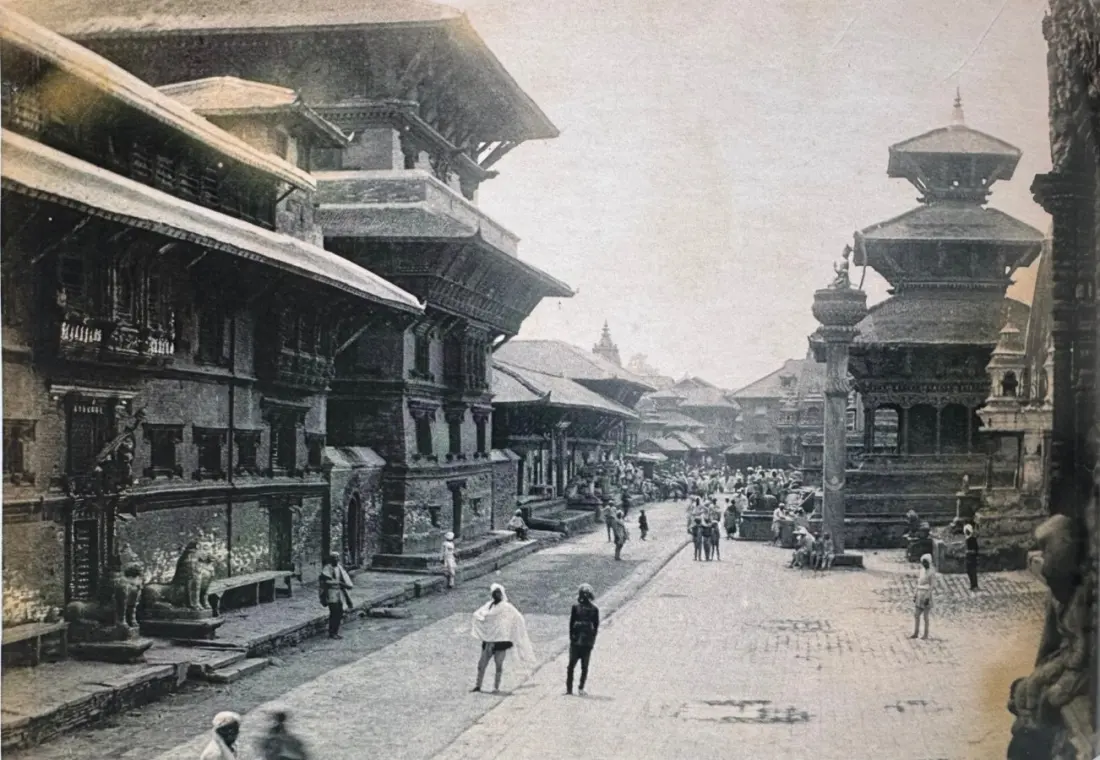
For decades, Joseph Gaye was a nobody in the record of Nepal. Then his Canadian great-granddaughter found a stash of his glass negatives and prints in an attic, and suddenly there is a rich visual record of Kathmandu in the late 1880s — now published as a limited-edition book, The Photography of Joseph Gaye: Nepal, India and Burma 1888-1899.
Gaye was born in Kent in 1852 and joined the British Army's Rifle Brigade, serving as a bandmaster on the Northwest Frontier. In 1888, Prime Minister Bir Shumsher Rana hired him to train the Nepali Army's marching band. Gaye spent four years in Kathmandu with his wife Mary Elizabeth Short, and while he was at it, he photographed almost everything he saw.
The results are striking precisely because they are not the usual royal court portraits. Early photography in Nepal, beginning with Clarence Comyn Taylor's images of 1863, tended to focus on the Rana rulers, their palaces and hunting trips. Gaye, by contrast, pointed his camera at ordinary people: Newar farmers working rice fields along the Bagmati — floodplains now buried under the city's sprawl — shoppers crowding Asan market, prisoners lounging in a Kathmandu jail, and even a posed group portrait of leprosy patients. His coverage starts en route, with images taken on the old trail from Sugauli over Bhimphedi and Chitlang into the valley.
Of the 211 prints in the book, 91 come from glass plate negatives, 83 from lantern slides, 32 from albumin prints and five from cellulose acetate negatives. The originals sit at the British Library in London, with digital copies held at the Madan Puraskar Library in Patan. Historian Pratyoush Onta helped with the text and captions after Gaye's great-granddaughter, Mary Margaret Gaye, made contact.
Why should a traveller care? Because Kathmandu is famously layered — medieval squares stacked against concrete — and images like these make the layers legible. Standing in Asan today, you can now picture the same bazaar 130-odd years ago, and the Bagmati farmland that became the city's core. Gaye's photographs, along with the work of earlier figures like Samuel Bourne and Nepali photographers Dirghaman and Ganeshman Chitrakar, are also a reminder that the country's heritage was documented in detail long before the tourist era.
Anyone heading to Kathmandu with an interest in its history can see much of this visual record firsthand: the British Library holds the original prints, while the Madan Puraskar Library at Patan Dhoka keeps digital copies in a corner of the old city that is itself one of the best-preserved historic quarters. Pair a library visit with a wander through Asan and a walk along the Bagmati, and Gaye's Nepal stops feeling like another world.