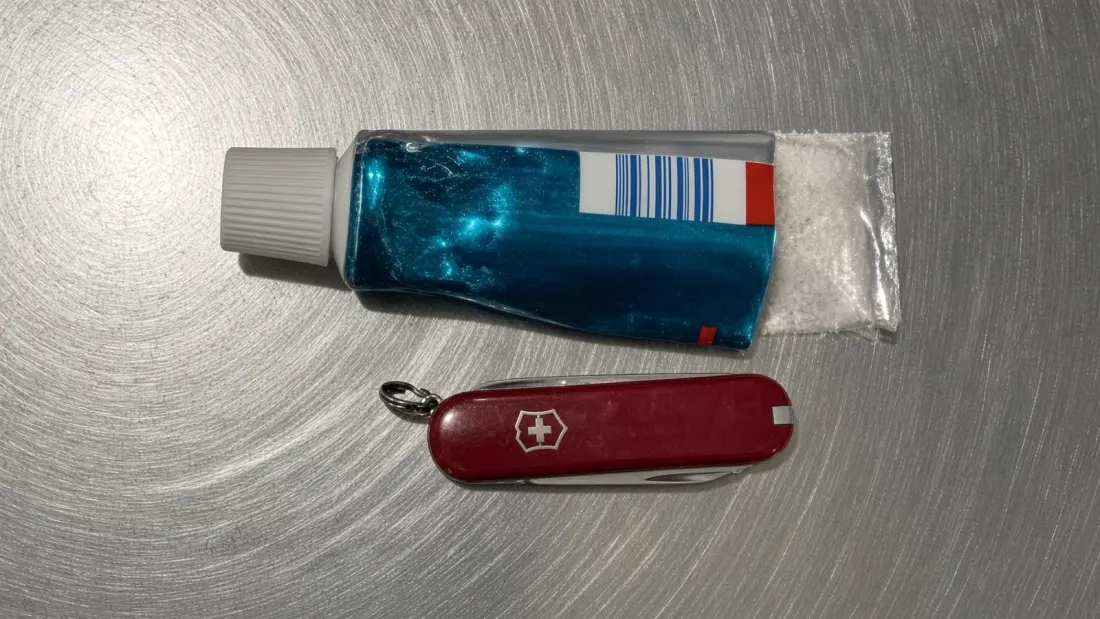
A couple going through security at Dallas Love Field thought they'd found a clever trick: a small red pocketknife tucked inside a toothpaste tube. TSA screeners saw something metallic near the toiletries on the X-ray, pulled the bag, and — after a second scan to narrow things down — found the hidden blade. The couple said their son had suggested the hiding spot. They surrendered the knife and made their flight.
The agency's local leadership hailed it as an "excellent catch," but the more interesting story is what this says about knife rules in general — because TSA's own history with pocketknives is contradictory, to put it kindly.
Here's the odd part: you can walk through a US checkpoint with scissors whose blades measure nearly four inches from pivot to tip. That's been allowed since December 2005, when TSA decided to shift attention toward explosives. A Government Accountability Office review found zero onboard incidents involving the newly permitted items. Yet a pocketknife with a blade half that length is banned outright, no matter how harmless it looks.
TSA actually tried to change this. In March 2013, it announced that small knives would be permitted from April 25 that year — blades up to 2.36 inches long and half an inch wide, no locking or fixed blades, no molded grips. Then-administrator John Pistole told Congress the agency needed to focus on threats that could actually bring down a plane, noting reinforced cockpit doors had changed the calculus, and that billions of passengers had flown since the scissors change without a single disruption. Flight attendant unions, airlines and lawmakers pushed back hard. TSA delayed the policy, scrapped it in June 2013, and in 2018 Congress wrote the knife ban into law, allowing only plastic and butter knives.
So when TSA celebrates catching a knife it once argued wasn't worth screening time, it's fair to ask what the publicity actually proves. Past internal testing suggests it proves very little. In 2015, leaked results showed screeners missed mock explosives and weapons in 67 of 70 tests — a failure rate around 95%. A 2017 report found an 80% failure rate. The latest round of covert checkpoint testing was reported in November 2025 by the DHS inspector general, but the results remain classified.
None of this means you should try your luck. Deliberately concealing a prohibited item is a serious offence, and most travellers caught with a stray knife simply hand it over and board. The practical takeaway is boring but real: know what's allowed before you pack. Scissors under four inches are fine; any pocketknife is not, regardless of blade size. And don't hide anything in toiletries — X-ray operators have seen it all, and the toothpaste trick has now been publicly demonstrated not to work.