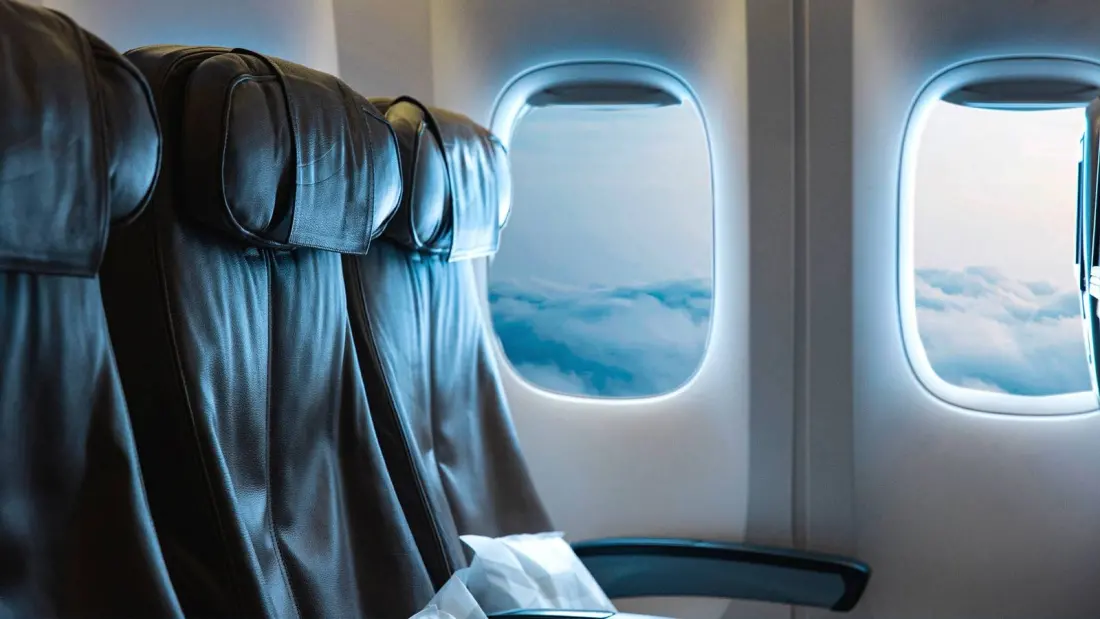
That little oval of plastic next to your seat is doing far more than framing the clouds. Its rounded shape exists because of a deadly lesson from the 1950s, when the de Havilland Comet — the world's first commercial jetliner — flew with large square windows. Repeated pressurization cycles concentrated stress at the sharp 90-degree corners, triggering metal fatigue and catastrophic mid-air breakups. The fix was simple and permanent: eliminate the corners. Round the frame, and cabin pressure flows smoothly around the hole instead of pooling at a single point.
Ever since, windows have been an engineering compromise. Every opening in the fuselage needs heavy reinforcement, and manufacturers size them carefully against the structural ribs of the airframe. That's why windows vary so much between aircraft: a Boeing 787 Dreamliner window measures roughly 10.7 by 18.4 inches, the largest in the industry, while an Airbus A320 family window is a modest 9.0 by 12.3 inches. The Dreamliner, Embraer's E-Jets, and the A220 all beat older designs like the classic 777 (10 by 15 inches) and the A350 (9.5 by 13.5 inches).
The fixed, rib-dictated spacing also explains a familiar frustration: the 'windowless' window seat. Airlines compress seat pitch using floor seat-tracks that don't care where the airframe holes fall, so paying extra for a window sometimes leaves you staring at a blank plastic wall for six hours.
The next chapter began in 2009, when Boeing's 787 introduced electronically dimmable windows — Airbus followed on the A350 in 2022. An electrical current darkens an electrochromic gel between the panes, replacing the plastic shade. The catch: crew hold a master override in the galley, so control moved from passenger to airline. Defensible for cabin-wide sleep on long-haul flights, but annoying if Greenland drifts past at 38,000 feet and your window is locked dark.
The bigger threat is the 'digital window' — a 4K screen fed by exterior cameras. Emirates already fits virtual windows to the middle-row first class suites on its 777s, where a real window is impossible. For a windowless cabin, the maths is tempting: no reinforced holes means a lighter, smoother, more fuel-efficient tube, and windowless concepts already appear in supersonic jet design proposals.
The problem is that a screen isn't a window. A real one lets your eyes focus to infinity and shifts perspective with your head (parallax); a flat display two feet away does neither, and your brain notices immediately. Add blue-light-heavy pixel output scrambling circadian rhythms, screens adding to an already screen-saturated cabin, and any camera latency colliding with your inner ear during turbulence — a recipe for motion sickness — and the case for replacing glass with LCD gets very shaky. The next time you snag a true window seat, you're holding onto a small piece of hard-won aviation history.