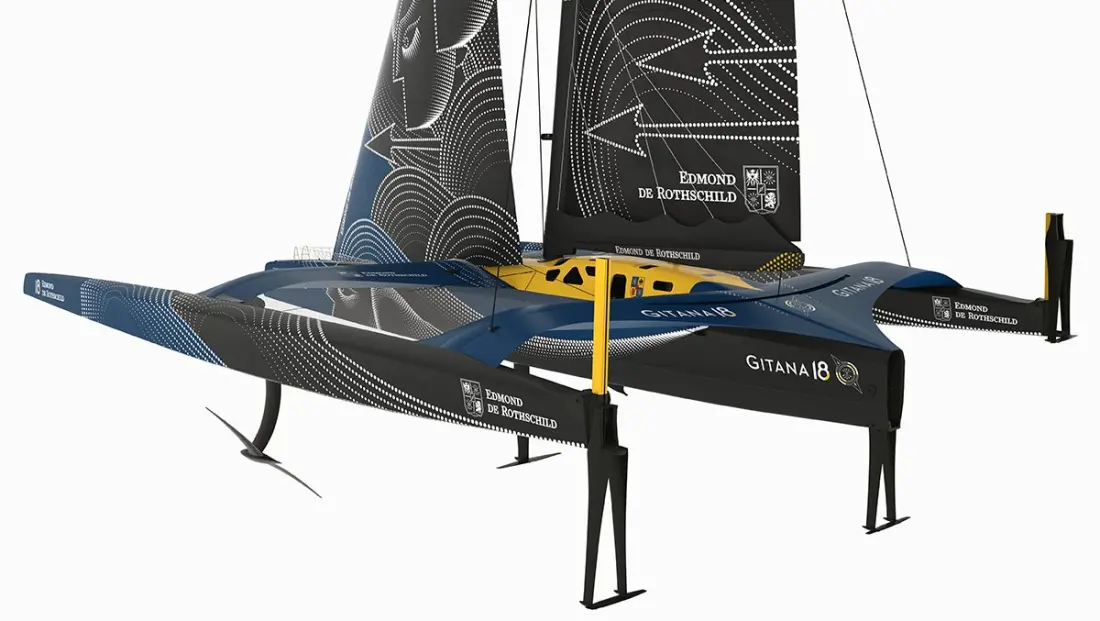
Most sailors will never steer anything above 20 knots. Charles Caudrelier now considers 40 knots an ordinary afternoon. The French skipper has been putting the brand-new Gitana 18 through its paces at the team's base in Lorient, Brittany, ahead of November's Route du Rhum, and journalist Matt Sheahan of Yachting World joined a trial sail to find out how a 32-metre foiling trimaran can be sailed solo at speeds that would terrify most of us.
The answer is engineering. Gitana 18 carries roughly three times as many hydraulic systems as her predecessor, Gitana 17, and her helm is a small, sports-car-style wheel with a lightness and precision Sheahan compares to a grand prix race boat a third of the size. The trick is a fly-by-wire steering setup — electric motors driving the rudders, much as in modern cars — which delivers both direct response and feedback. The rudders even turn at different rates depending on whether they're inside or outside a turn, making manoeuvres more efficient.
None of this relies on automated foil control, which is banned in the Ultim class; foil trim is done by hand. The boat's T-foils sit on America's Cup-style canting arms that work independently to fine-tune lift, while the main hull's canting daggerboard has a T-foil with flaps and a trim tab — and the whole assembly can rake fore and aft. It's a dense web of interacting systems, yet the team reached a level of confidence within three months and 30 days of sailing that Caudrelier says would normally take several seasons. During that period he completed a 1,500-mile solo qualifier, pushing the trimaran beyond 40 knots alone at sea.
The contrast with the old boat explains why it matters. On Gitana 17, Caudrelier was comfortable up to about 40 knots; above that she became twitchy, and in the low-to-mid 40s he twice experienced a Chinese gybe — a violent, uncontrolled crash-gybe — while sailing single-handed offshore. Gitana 18's stability at speed is what turns those white-knuckle moments into what he now calls normal.
For travellers and sailing fans, the story is a window into the cutting edge of offshore racing, and into Lorient itself — the Brittany port that has become the nerve centre of French ocean racing, home to IMOCA and Ultim teams and the start port for races like the Route du Rhum. Even if you'll never helm a foiling giant, seeing these boats up on the hard or training off the Breton coast is a genuine spectacle, and the city's sailing heritage runs deep. Keep an eye on November's Rhum start too: Caudrelier will be one of the favourites, on a boat that makes 40 knots look easy.