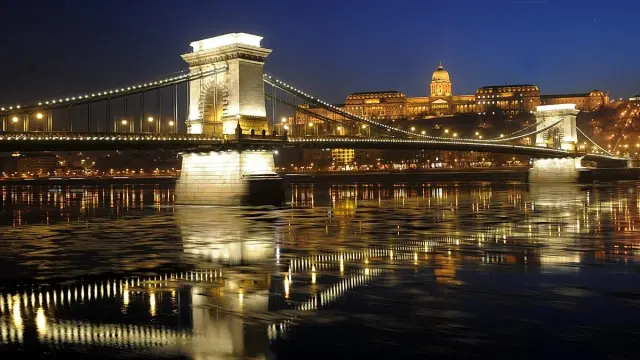
An AI-driven study has crunched millions of street images to answer a deceptively simple question: which city centres do people actually find pleasant? Budapest came out impressively well, landing 10th place out of 162 cities across 70 countries.
The StreetPulse project, built by researchers at Corvinus University of Budapest and the Toulouse School of Economics, analysed over three million street-level images using Google Street View. Each city centre was scored within a two-kilometre radius of downtown on seven criteria: beauty, perceived safety, vibrancy, walkability, historical character, comfort and perceived affluence. Paris topped the table with 6.29 out of 10, followed by Amsterdam, St Petersburg, Barcelona and Vienna. Budapest averaged 5.83 — comfortably ahead of most major capitals.
Dig into Budapest's individual scores and a clear picture emerges of what makes the Hungarian capital work. Its historic core scored highest for perceived affluence (6.40) and historical character (6.38), with solid marks for pedestrian-friendliness (6.31) and perceived safety (6.30). Beauty landed at 6.05. The weaker spots? Comfort, at just 4.82, and vibrancy at 4.55 — the AI suggests the grand architecture doesn't always translate into a relaxed, lively street-level experience.
The radius also mattered. Budapest slipped to 15th when the analysis widened to five kilometres, and 42nd when the wider urban area was assessed — a reminder that the gorgeous inner city is doing most of the heavy lifting. In a parallel ranking using open-source imagery from Mapillary and Panoramax, Venice, Paris and Amsterdam led, with Budapest 26th.
There's a practical side for travellers too. The StreetPulse platform is open to the public: you can compare neighbourhoods, build your own city rankings and even browse street images side by side. Lead researcher César Hidalgo says the team plans to add criteria and work with local authorities — the data could help planners spot neighbourhoods where safety, public space or infrastructure need attention, including areas cut up by big roads.
Why should a traveller care? Because it's a data-backed nudge towards a city many still treat as a cheap weekend stop rather than a destination in its own right. Budapest's compact inner district — think the Danube embankments, the Jewish Quarter's streets, and the ring of grand 19th-century boulevards — measures up to the walkable centres of Paris, Amsterdam and Vienna. That pedestrian-friendly core means you can genuinely cover the highlights on foot, from market halls to riverside coffee houses, without hunting for trams. And knowing the wider outer districts scored lower, it's smart to anchor your stay inside or near the historic centre rather than out by the motorways. Anyone who loves wandering cities with their head up will find plenty here — the AI agrees.