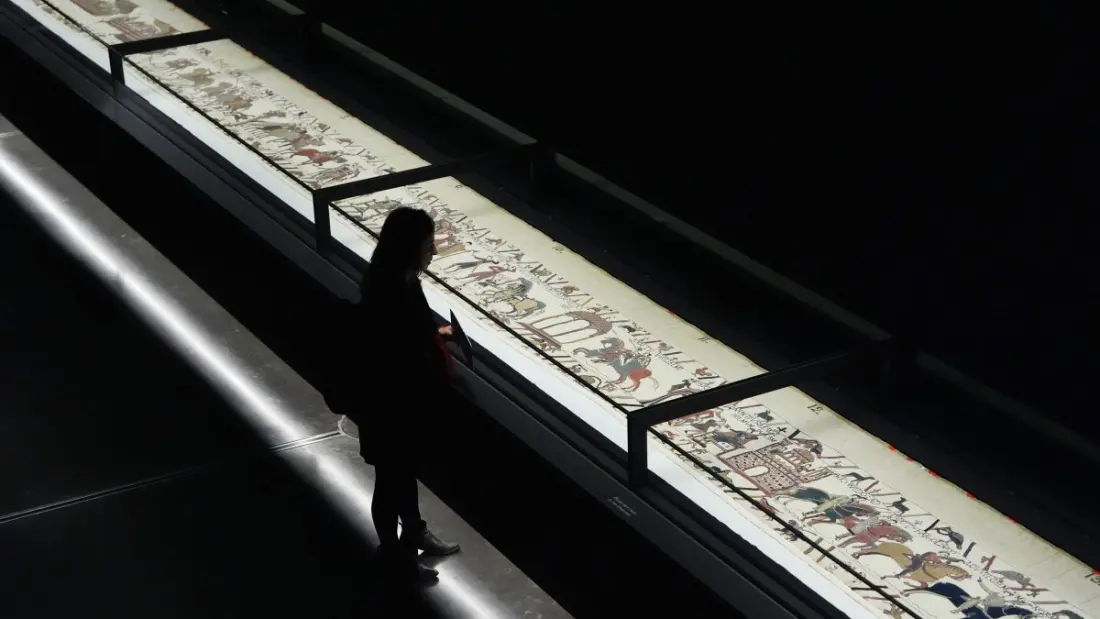
France's famous Bayeux Tapestry is getting a permanent change of posture. Culture minister Catherine Pegard has confirmed that once the 68-metre embroidery returns from its blockbuster loan to the British Museum, it will never be hung on a wall again. Instead, it will lie along its full length on an inclined table — a setup designed both to protect the fragile textile and, as a bonus, to make it easier for visitors to see.
The tapestry, nearly 1,000 years old, has been on show horizontally in London since September as the centrepiece of an exhibition at the British Museum that has drawn around 100,000 visitors. France's culture ministry calls it the museum's bestselling show. The trip hasn't been entirely stress-free: two broken threads were spotted after the crossing, though officials insist the piece remains in the same overall condition. Conservation experts had warned from the start about moving something this delicate, and the debate got political — far-right MP Jean-Philippe Tanguy called the no-hanging decision a "scandal" and claimed, without evidence, that the tapestry had been damaged in transit.
The switch to an inclined display has actually been on the table, so to speak, for about a decade, according to Pegard. It will be implemented as part of a full renovation of the Bayeux Museum in Normandy, where the tapestry hung vertically-ish from the 1980s until this year. When it returns next year, visitors will see it in a redesigned museum with a completely new presentation.
For anyone who doesn't know the object: the Bayeux Tapestry is a 224-foot-long embroidered cloth telling the story of the 1066 Battle of Hastings, when William the Conqueror's Norman fleet crossed the Channel and conquered England. Its exact origins remain murky, though scholars generally believe it was stitched in England before ending up in Bayeux, where it has been displayed more or less continuously for centuries. It's essentially a medieval comic strip in wool and linen, and one of the very few surviving artworks of its kind.
Why should travellers care? Two practical reasons. First, if you've been putting off a trip to Normandy, the next year or so is a window to catch the tapestry in London instead — or, if you'd rather see it at home, you'll need to wait for the renovated Bayeux Museum to reopen. Second, the inclined-table format should genuinely improve the viewing experience. Anyone who has shuffled along the old dimly lit gallery knows the embroidery was hard to appreciate up close; a gentle slope at eye-adjacent level, along the entire length, should let you follow the story scene by scene the way its medieval makers intended.
Bayeux itself makes an easy add-on to a Normandy trip — it's a charming small town within reach of the D-Day beaches, Caen and the Norman coast. If the tapestry is your anchor, plan around the museum's reopening and check booking requirements in advance; post-renovation reopenings of headline attractions tend to sell out fast.