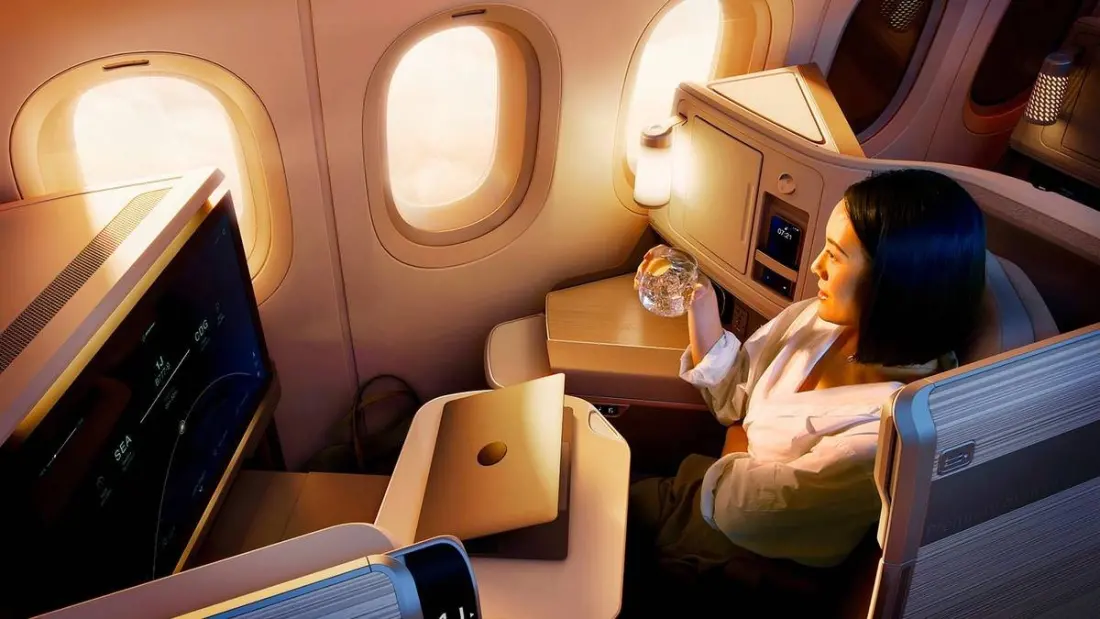
Boeing's long-delayed 777X is finally edging towards service, and the cabin is where passengers will notice the change. Drawing on details shared by Boeing's own cabin team with trade press, here's what's actually different inside the new widebody — and why it matters if you're booking a long-haul flight in the next few years.
The clever part is that Boeing didn't widen the fuselage. The 777X uses the same cross-section as the existing 777, but thinner sidewall materials free up four extra inches of cabin width — 235 inches versus 231 on a 777-300ER. That may not sound like much, but it gives airlines flexibility in how they arrange seats, especially in premium cabins where an inch or two can mean the difference between a cramped suite and a comfortable one.
Overhead, the arched ceiling does away with the centre bins in first and business class, creating a taller, airier feel in the zones where airlines charge the most. Air quality improves too: the cabin is pressurised to the equivalent of 6,000 feet with higher humidity, and larger windows — about 16% bigger than older 777s — sit higher and rounder on the fuselage so shorter passengers can actually see out of them.
The windows themselves are a standout. Boeing's electronically dimmable windows, familiar from the 787 Dreamliner, use a gel layer between panes that darkens when charged. On the 777X they block 99.999% of visible light and darken twice as fast as before, so pull-down blinds become optional rather than standard.
Airlines also get unusual freedom to customise ceiling treatments, sidewalls and bins — even mixing different designs within one aircraft while keeping the look cohesive. For frequent flyers, that means every 777X you board may feel subtly different depending on the carrier.
The catch is timing. Boeing holds a 'shadow fleet' of dozens of early-build 777-9s — nicknamed the 'Terrible Teens' — stored at Everett, Moses Lake and Victorville, some of which may never fly commercially because they'd need expensive rework to meet certification. Emirates and Lufthansa are reportedly refusing to take them, and United has publicly said it has no interest in buying the rejects at a discount. Meanwhile, a threatened engineers' strike was only averted by a four-year pay deal starting with a 10% rise — a walkout would have shut down the certification programme entirely.
For travellers, the 777X matters because it's set to become the backbone of long-haul fleets for decades, with room for 375 to 450 seats and a range of about 8,000 nautical miles. Expect airlines to lean on that premium cabin spaciousness when pricing business and first fares. If you fly long routes regularly, it's worth checking whether your next widebody booking is a 777X — the quieter, lighter, roomier cabin could genuinely change how you feel at the end of a 12-hour flight. Original reporting via Simple Flying.