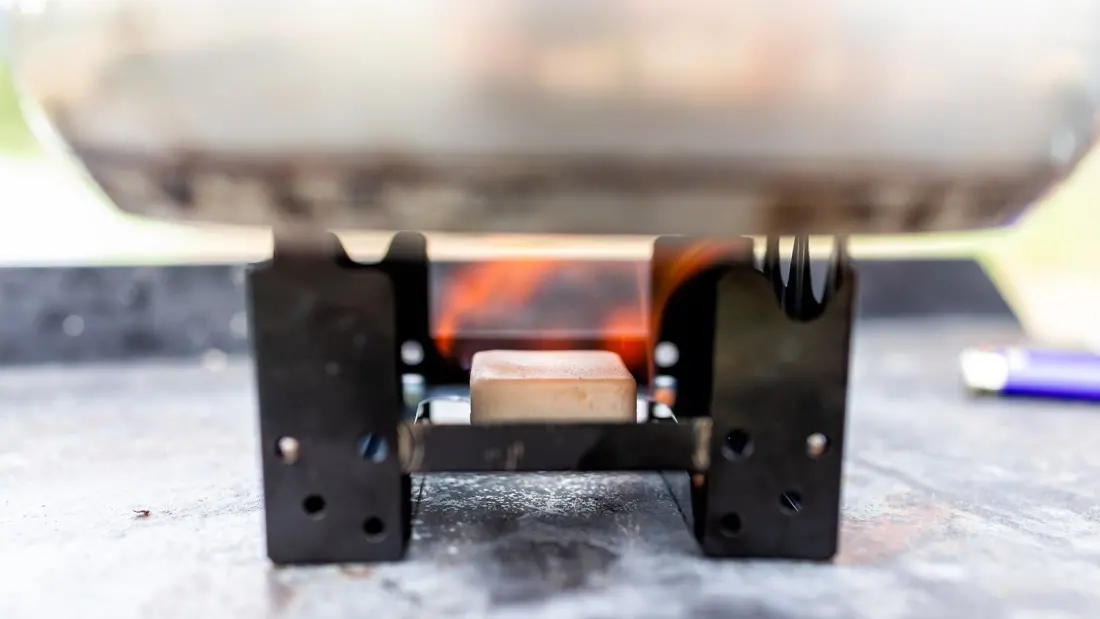
Solid-fuel hexamine stoves are cheap, featherweight and almost impossible to break — and yet almost nobody carries them anymore. A recent first-person gear review from Backpacker explains why, and it's a useful cautionary tale for anyone assembling a winter hiking or emergency kit.
The writer's warning comes from hard experience. During the Grand Traverse, a roughly 40-mile ski mountaineering race from Crested Butte to Aspen, Colorado, organisers required every team to carry a stove. Hoping to save weight, the author and their partner packed a tiny solid-fuel burner plus a few hexamine tablets — about 5 ounces total, lighter than a 100-gram gas canister. Double-bagged and stuffed inside a beanie, the tablets still worked loose mid-race. The smell — regularly compared to rotten shellfish or dead carp — soaked into everything. The beanie needed multiple wash cycles and a month of airing out before it stopped reeking.
The odour is only half the problem. Hexamine tablets are inefficient: it takes nearly two tablets (close to an ounce of fuel) to boil a litre of water, versus roughly 0.3 ounces for a pressure-regulated canister stove like the Soto Windmaster. On any trip longer than a day or two, that efficiency gap erases the weight advantage. They're also hard to light in the cold, painfully slow at melting snow, and banned in many fire-restricted areas because they lack an on-off switch — a genuine drawback for a stove you might need with numb fingers in an emergency.
The history is interesting, though. Esbit, the German company that invented hexamine tablets in 1936, saw demand explode during World War II when its burners became standard Wehrmacht issue; the Allies built their own versions. The format still has a following among European hikers, but American backpackers largely moved on.
So why do solid-fuel stoves survive at all? Simplicity. A canister stove can clog or lose its igniter; a folded solid-fuel burner can be stepped on and bent back into shape. But the review argues that even on simplicity, there's a better option: alcohol burners are just as cheap and light, smell better, and use fuel that's easier to source — Esbit even makes a model that doubles as a fuel-storage bottle.
The practical takeaway for shoppers: skip the ultralight titanium solid-fuel burner trending on backpacking forums. For about $5 and 12 grams more — roughly the weight of a AAA battery — the BRS-3000T canister stove delivers far less hassle. Esbit-style burner kits still start as low as $12 with fuel included, which may tempt bargain hunters, but the efficiency maths and the smell make them a poor pick for all but die-hard traditionalists.