
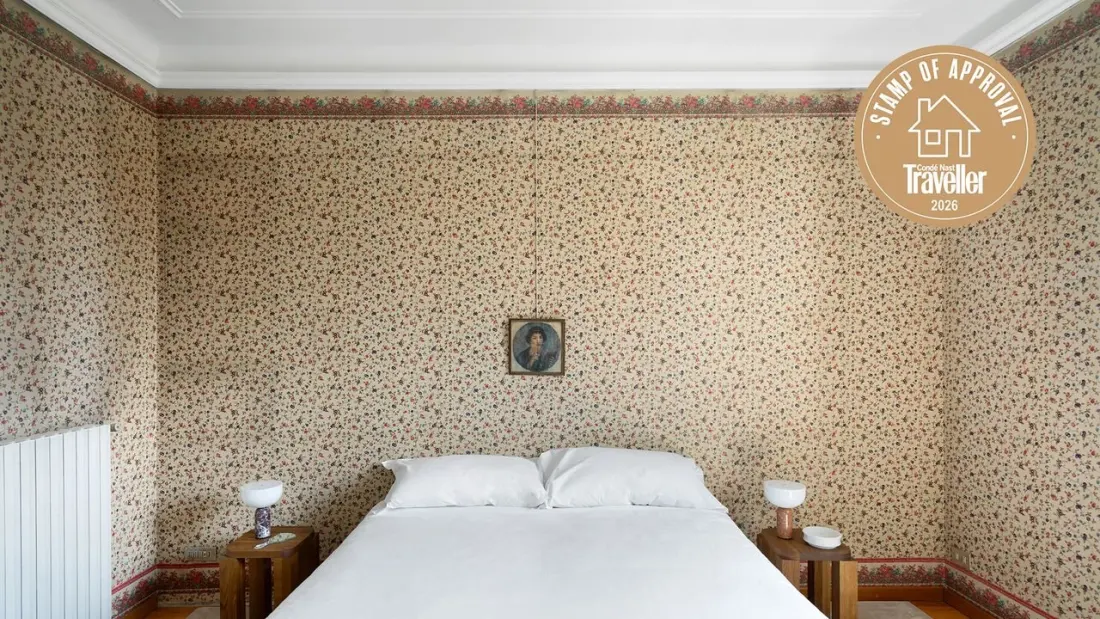
There's a private lane in central Milan that gives nothing away from the street. Behind its gates sits Casa Osti, a three-storey, five-bedroom homestay in a leafy residential pocket of the city — and a rare chance to sleep inside an example of Milan's Stile Liberty, the Italian take on Art Nouveau that flourished in the early 1900s with floral motifs, coloured glass and intricate ironwork.
What makes the villa work is that it never feels staged. Books sit on tables, objects look collected rather than styled, and vintage photographs and artworks hang from the ceiling so the walls stay untouched. Bedroom lamps and fittings are original to the house, and the honest imperfections — a chipped radiator, a mark in the wallpaper — are reminders that a family actually lived here.
The neighbourhood rewards those who treat the stay like residence rather than sightseeing. The Mercato Settimanale di Via Osoppo, held on Thursdays and Saturdays, is where locals shop, not tourists — perfect for picking up ingredients for dinner in the villa's big communal kitchen. The writer cooked spaghetti al pomodoro both evenings and ate outside under the magnolia tree with a bottle of Italian wine, concluding that doing something so ordinary in such an extraordinary setting is half the appeal. Ten minutes' walk away, Bar Pasticceria Moriondo serves pastries and strong coffee to a chorus of buongiorno from regulars, with barely a visitor in sight.
When the city does beckon, tram 16 runs from near the lane towards the Duomo, and it's a long but pleasant walk from there to Fondazione Prada, where Wes Anderson's Bar Luce makes an amusing pitstop. Despite being central, the villa is remarkably quiet — thick shutters kept out the August heat and morning light, meaning slow starts with coffee in bed were entirely possible.
The overall verdict: this is the kind of place that converts museum-planners into garden-loungers. Some afternoons were spent reading and watching light move across old floors rather than ticking off sights. The one caveat — August heat — suggests a spring or autumn visit instead.
For travellers tired of interchangeable hotels, Casa Osti shows why homestays can be the sharper choice: local knowledge from the owners, a kitchen to cook in, and a city experienced through the everyday rituals of the people who live there rather than through the postcard version.