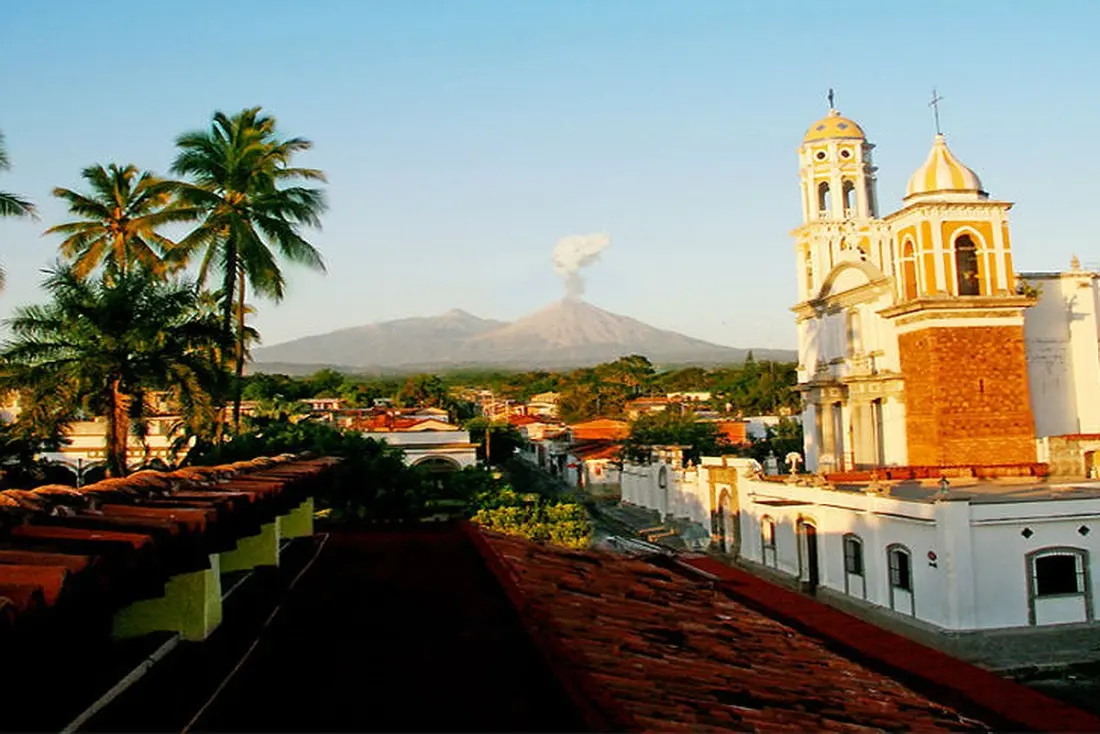
Most travellers chasing a life in Mexico end up comparing Lake Chapala, Puerto Vallarta or the Riviera Maya. There's another option, though, far off the well-worn expat trail: Comala, a small colonial town of about 9,600 people in the state of Colima, sitting at the foot of one of Mexico's most active volcanoes.
The setting is hard to beat. Volcán de Colima — locally called Volcán de Fuego — looms over a fertile, subtropical region of coffee farms and orchards. Daytime temperatures average around 30°C year-round, cooling to about 18.5°C at night, with a rainy season running roughly from late June to October. The town sits 90 minutes inland from the Pacific coast, which gives some shelter from hurricanes, and it's only 20 minutes from Colima city (population around 295,000) for hospitals, big-box shops and other urban services. Guadalajara is about 2.5 hours by road.
What makes Comala appealing is what it isn't. There's no concentrated expat enclave here — foreign residents are few, scattered and integrated into local neighbourhoods. The economy runs on pesos, not dollars, so rents and house prices haven't inflated the way they have in better-known gringo hubs. Everyday costs sit at or below the Mexican average, and Mexico generally is considerably cheaper than the US, Canada or Europe.
Daily life has real charm. The main square is the social heart, ringed by botaneros — arch-lined restaurants serving complimentary regional tapas with your drinks. The town is famous for ponche, a fruit-and-nut alcoholic drink you can sample free in local shops, and its bakeries turn out pan dulce seven days a week, busiest before sundown when families buy bread for supper. Local coffee, grown on the volcano's slopes, is excellent. Climb higher towards the volcano and the climate turns noticeably cooler and temperate, which is why some Colima city residents keep weekend homes up there.
There are honest caveats. Spanish is essentially essential — you won't get by on English here as you might in Ajijic or Puerto Vallarta. The rental market is thin, especially for furnished places, so word-of-mouth and patience matter more than agents; newcomers often rent short-term in Colima city while hunting. Property prices have risen over the past decade, particularly along the road up the volcano, but remain well below equivalent homes in Chapala, Vallarta or Manzanillo. And the region carries natural risks: the volcano last erupted significantly between 2013 and 2017, and the state is earthquake-prone.
Who is this for? Settled travellers, remote workers and retirees who want an authentically Mexican small-town life with genuine community integration, and who are willing to learn the language and navigate a market that won't hand them a turnkey rental. If you want an English-speaking bubble, look elsewhere; if you want ponche on the plaza and volcano views for a fraction of enclave prices, Comala deserves a place on your shortlist — or at least a week's visit to see if the pace suits you.