Corfu doesn't look like the Greece of postcards. The second-largest of the Ionian Islands, off the country's northwest coast, it's startlingly green — olive groves and cypress rather than the bare rock of the Cyclades — and its architecture tells a different story too. Venice ruled here for roughly 400 years, then the French and British took turns, and the Ottomans never did. You can taste all three legacies: Italianate arcades, a Paris-inspired promenade, and cricket and ginger beer on the main square.
Start in Corfu Old Town, a UNESCO World Heritage Site of narrow lanes (kantounia), ochre-and-pink Venetian townhouses and the red-domed church of Saint Spyridon, the island's patron. Go early or in the evening, when the cruise crowds thin out. Next door, the Liston arcade faces Spianada Square, one of Greece's largest, where you can watch a cricket match with a tsitsibira — local ginger beer — in hand. The Venetian Old Fortress on its rocky headland gives the best rooftop-and-sea views, and the less-visited New Fortress has tunnels and ramparts of its own.
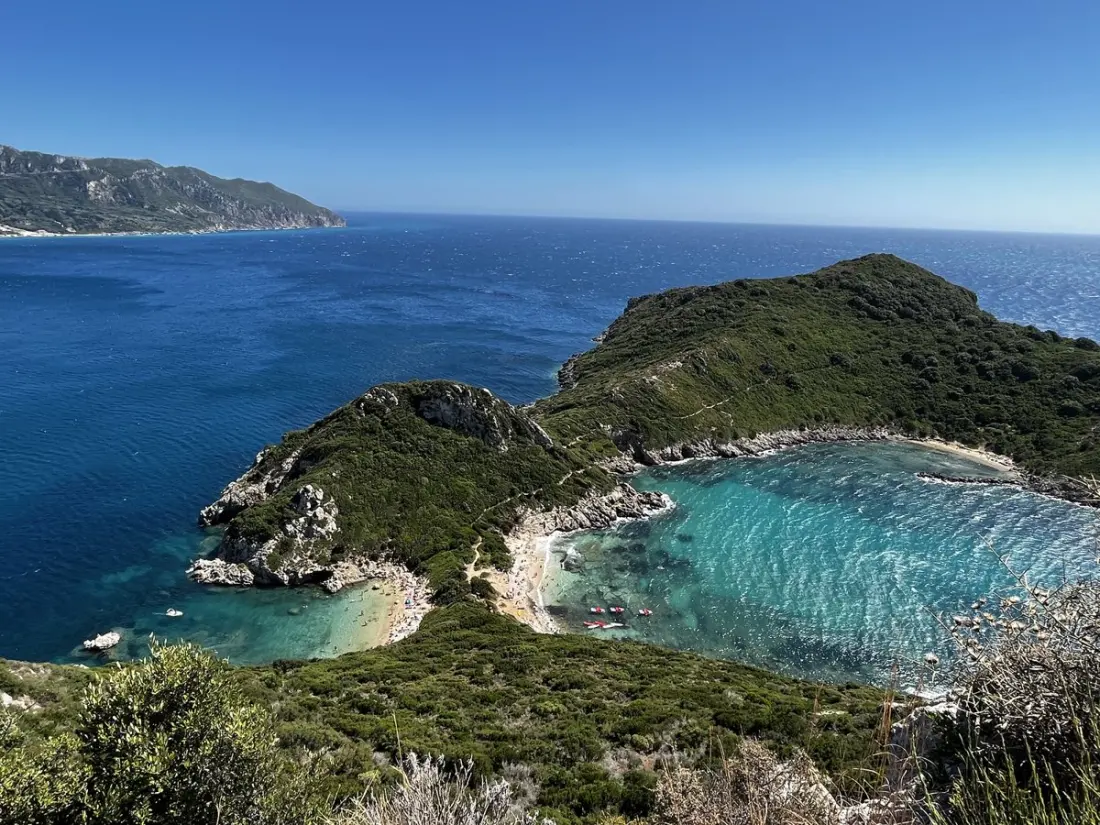
The coast is where Corfu really earns its keep. Paleokastritsa on the west side stacks small bays of blue-green water against forested cliffs, with a 13th-century monastery above and boat trips to sea caves below. Nearby, the hike from Afionas village to Porto Timoni takes 20–30 minutes each way and delivers the island's famous double beach — two crescents back to back. It's rocky, there are no facilities, and midday is brutal, so go early with proper shoes. Further north, the sandstone channels of the Canal d'Amour at Sidari come with a love-charm legend, while quieter Cape Drastis is the better bet for drama without the crowds.
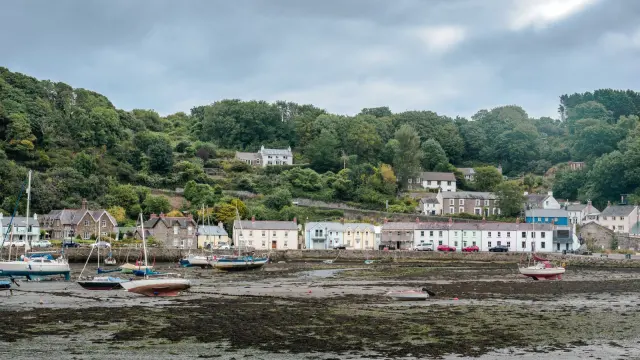
Inland and north, the picture changes again. Old Perithia, a Byzantine-era mountain village abandoned in the 20th century, is being slowly restored and now has tavernas serving slow-cooked sofrito and spicy bourdeto. The winding road up Mount Pantokrator (906m) ends near the summit with views to mainland Greece and Albania. On the northeast coast, fishing villages like Kassiopi, Kalami and Agni face Albania across a calm strait — Kalami's White House is where Lawrence Durrell wrote in the 1930s.
Two easy add-ons make Corfu a genuine base rather than a single-island trip. Fast boats run to Paxos and Antipaxos, whose blue caves and turquoise lagoons are among the best water in the Ionian — worth a night or two, not just a day cruise. And the ferry from Corfu Port to Saranda in Albania takes about 30 minutes, putting the ancient ruins of Butrint within reach of a morning.
Practical notes: Corfu has its own international airport with summer direct flights from across Europe; a rental car is the way to see the west coast beaches (Glyfada, Rovinia, Agios Gordios among them) since the best ones are scattered. The Achilleion Palace, built in the 1890s for Empress Sisi of Austria, costs €7 to enter and pairs nicely with a Corfu Town morning. Try the kumquat liqueur — a British-introduced crop that's now the island's signature souvenir.
Story via Wild Junket