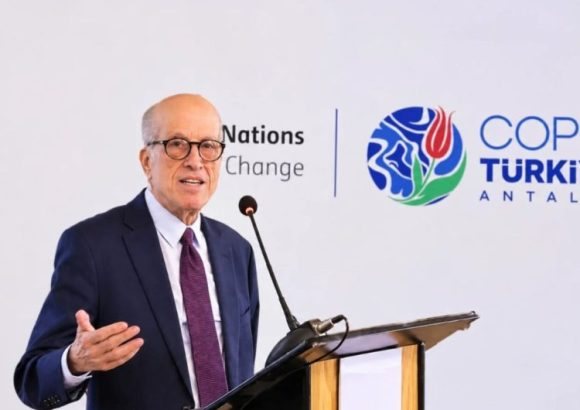
The Dominican Republic, one of the Caribbean's most-visited holiday destinations, has used the COP31 climate talks in Antalya, Turkey, to make a pointed argument: countries like itself cannot deliver on ambitious climate promises without real international money behind them.
Leading the case was Max Puig, executive vice-president of the National Council for Climate Change and Carbon Markets and co-chair of the Dominican delegation. His framing was blunt — the climate crisis is also a crisis of justice, development and international responsibility. He pressed major emitters to cut greenhouse gases faster, in line with science and the Paris Agreement, and to keep the goal of limiting warming to 1.5C alive.
The core of the Dominican pitch was finance. Puig argued that developed countries must honour existing climate-finance commitments without loading more debt onto vulnerable nations, and that funding needs to be accessible, predictable, concessional and delivered on time — aimed squarely at adaptation, disaster-risk reduction and resilience. For a country whose economy leans heavily on beaches, resorts and agriculture, those are not abstract categories; they are the infrastructure tourism depends on.
The delegation also highlighted the gap in the Loss and Damage Fund. Requests to the fund total roughly US$2.8 billion, but only about US$342 million is currently available — a shortfall Puig wants addressed. The Dominican Republic backed implementation of the Global Goal on Adaptation across water, food and agriculture, health, ecosystems, infrastructure, poverty reduction and cultural heritage, and pointed to the particular exposure of small island states.
Alongside the diplomacy, the country presented its own updated targets. NDC 3.0 commits to cutting emissions 28% by 2030 and 32% by 2035 against a business-as-usual scenario. The plan contains 26 mitigation measures and 41 adaptation measures, with a total investment requirement exceeding US$23.7 billion. Priorities include expanding renewable energy and fixing solid-waste management — the latter a visible quality-of-life issue for residents and visitors alike.
Why should holidaymakers care? The Dominican Republic welcomes millions of visitors a year to Punta Cana, Puerto Plata and beyond, and its beaches, reefs and farm supply chains are on the front line of Caribbean climate impacts — stronger hurricanes, coral bleaching, water stress. Adaptation money, or the lack of it, will shape how well those attractions and the communities around them hold up over the coming decades. The DR's message at COP31 was essentially this: the country is willing to do its homework, as NDC 3.0 shows, but a destination of its size cannot shoulder a bill like this alone.
For travellers, there is nothing to change about booking a trip now — resorts and airports operate as normal. But the story is worth following if you care about the long-term resilience of the places you visit, and about whether the funds meant to protect vulnerable coastlines actually materialise. Expect the Loss and Damage Fund's capitalisation to be one of the numbers to watch after these talks.
Story first reported by Dominican Today.