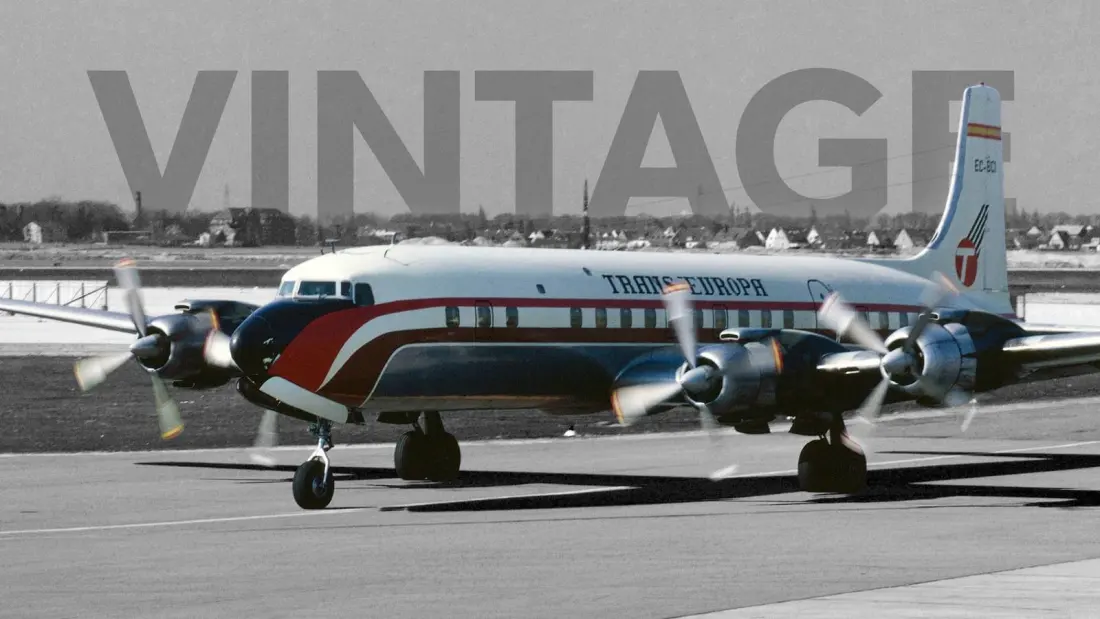
Before jets took over the skies, the Douglas DC-7 was as good as propeller-driven air travel got. First flown in 1953, the four-engine airliner could cross the United States nonstop — New York to Los Angeles in under eight hours — which was a genuine selling point when airlines like American and United were racing to beat Lockheed's Super Constellation. Powered by Wright R-3350 Duplex-Cyclone engines, it topped out around 406 mph and carried up to 105 passengers.
Its reign was brief. The DC-7 was mechanically fussy — those powerful engines ran hot and were prone to failure on long transcontinental routes — and when the Boeing 707 and Douglas DC-8 arrived in the late 1950s, jets were quieter, faster and cheaper to run. Airlines retired their piston fleets quickly; Delta, an early adopter in 1954, flew the type until 1968. In total, more than 20 US carriers and operators in over 30 countries used the DC-7, with variants like the DC-7B and long-range DC-7C extending its reach overseas. By the end of the 1960s, most surviving airframes had been converted into freighters or scrapped.
So where can you actually see one? The Delta Flight Museum in Atlanta holds a well-preserved example, and the Pima Air & Space Museum in Tucson displays a DC-7B that United once flew before handing it over to cargo operators. The final passenger DC-7 built (1956) sits at Epic Flight Academy. Flying examples have all but vanished: 'Tanker 60', one of the last airworthy aircraft, made its final flight in October 2020, and a restored Eastern Air Lines DC-7B (N836D) was grounded after an engine failure in 2013. Restoring one today is a stretch — parts are scarce, overhauls are expensive, and few mechanics still know vintage radial engines.
The story has a military footnote worth knowing. Douglas's piston-powered A-1 Skyraider, a heavily armed attack aircraft, became a legend in Vietnam for its long loiter time and rescue missions, and was the last US combat aircraft with a piston engine. Unlike the DC-7, Skyraiders — along with the Corsairs and Mustangs that fought the last piston dogfight over Central America in 1969, during the 'Football War' — still fly at airshows across the US and Europe.
For travellers, this is a reason to add an aviation museum stop to a trip. Atlanta's Delta Flight Museum pairs its DC-7 with the airline's own history, while Tucson's Pima Air & Space Museum is one of the largest aviation collections anywhere, ideal for a half-day wander among everything from WWII bombers to Cold War jets. If you're curious about the tail end of the propeller era, either visit delivers the roar-and-rivets experience that no modern flight can recreate. It's a niche pleasure, but a memorable one — and it's the only way left to meet America's last piston airliner in person.