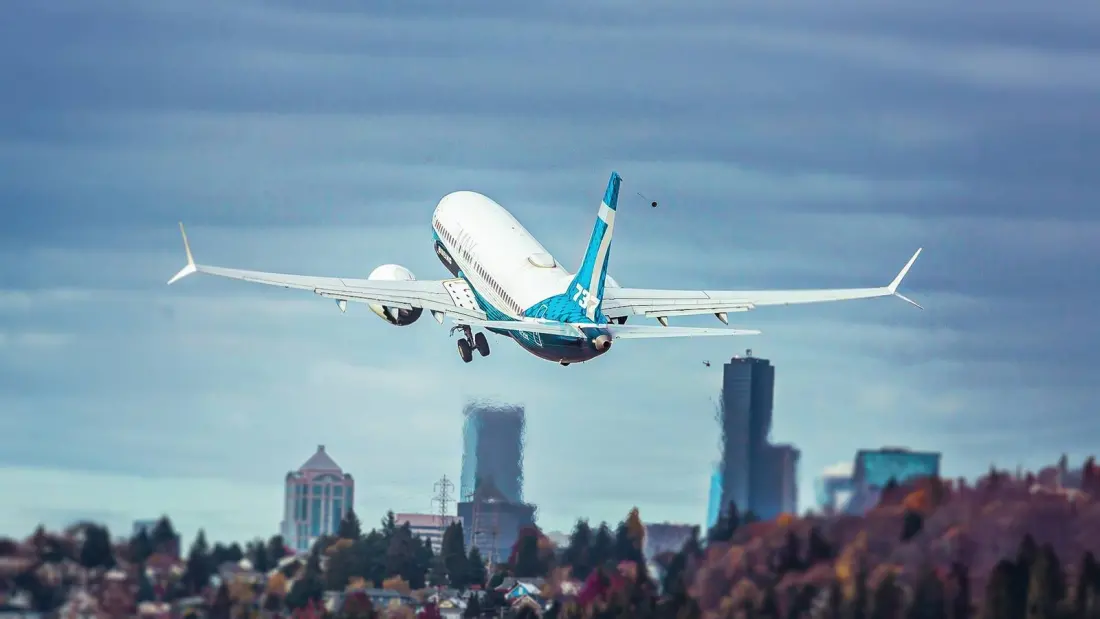
Every Boeing 737 MAX takeoff now operates under a quiet safety rule most passengers have never heard of: if the aircraft's two angle-of-attack sensors disagree by more than 5.5 degrees, the MCAS flight-control system shuts itself off and flashes an "AOA Disagree" warning to the pilots. It is the centrepiece of the rewrite Boeing made after the Lion Air 610 and Ethiopian Airlines 302 crashes of 2018 and 2019, which killed 346 people and grounded the fleet worldwide.
MCAS existed because of engine geometry. When Airbus's A320neo began winning orders, Boeing chose to update the 737 rather than design a clean-sheet aircraft. The MAX's bigger engines had to be mounted higher and further forward on the wing due to the 737's low ground clearance, which made the jet pitch up more aggressively at high power. To avoid costly simulator training and a separate type rating, Boeing masked the difference with software that automatically pushed the nose down. The fatal flaw: MCAS trusted a single sensor, and both crashes involved faulty data commanding repeated nose-down inputs the pilots could not overcome.
The redesigned system now cross-checks both sensors before activating, the disagree warning is standard on every jet regardless of optional equipment, MCAS can only fire once per high-AOA event, and it cannot apply more nose-down force than a pilot can counteract with the control column alone. Boeing has also gone further, flight-testing a "synthetic" third AOA reading calculated from five different aircraft parameters — a commitment made to European regulators before the MAX returned to service in early 2021 — plus a planned switch letting pilots silence a stick shaker triggered by bad data.
Pilot training has changed just as dramatically. Before the crashes, US crews got around 56 minutes of iPad-based differences training, and MCAS wasn't even mentioned in the manuals. Now there are computer-based modules, updated documentation and simulator sessions covering the MAX's flight-control systems. A 2020 Inspector General report laid bare why: Boeing had downplayed MCAS during certification, presenting it as a tweak to the existing speed trim system, while the FAA's delegation process meant the single-sensor design never got meaningful independent review.
Why should a holiday traveller care? If you're booked on a 737 MAX — and odds are decent, with hundreds flying for Ryanair, American, Southwest, United and others — you're boarding an aircraft whose most dangerous known failure mode has been engineered out, triple-checked and regulator-approved. The FAA has logged over 200 reports of faulty AOA sensors since 2004, so redundancy here matters. And with the MAX 7 and MAX 10 finally certified after years of delay, the fleet is set to keep growing, meaning the jet's safety record and oversight will stay relevant to anyone flying short and medium-haul routes in the coming decade.
Simple Flying