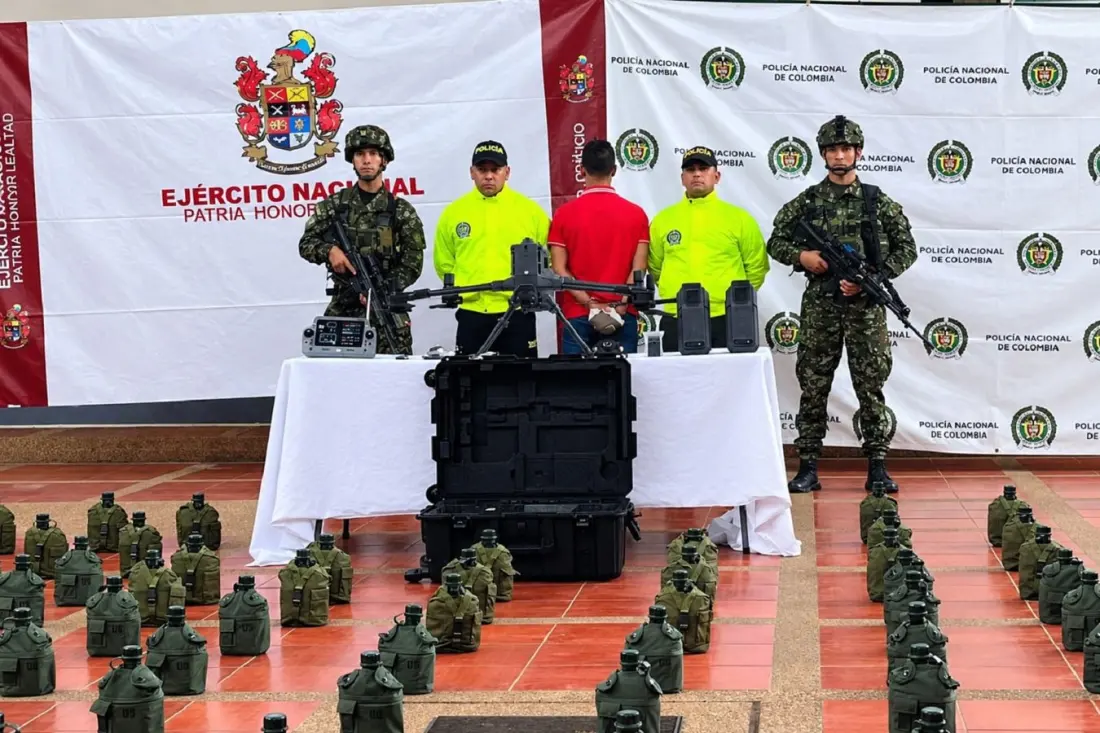
Colombia is now Latin America's hotspot for weaponised drone attacks, and the numbers keep climbing. An international intelligence report puts 418 incidents in the country so far in 2026, up from 333 across the whole of 2025 — a 125% jump that works out to more than one attack every single day.
The armed groups behind most of it are FARC dissident factions and the ELN, which have repurposed cheap commercial drones into tools of war. The devices let them drop explosives, scout military positions and intimidate communities without putting fighters in the line of fire.
Geographically, the problem is heavily concentrated in the country's south and border zones. Cauca accounts for 243 attacks — roughly 58% of the national total — followed by Norte de Santander (45), Valle del Cauca (33), Chocó (31), Nariño (12) and Antioquia (10). ACLED, which tracks political violence worldwide, found that 97 of the 182 Latin American municipalities where weaponised drone incidents have been recorded are in Colombia. Globally, the organisation has logged around 670 drone-weapon events in the region since 2018, and more than 72% of those occurred between January 2025 and August 2026.
What worries authorities most is how easily these groups get the hardware. Most drones are commercially sourced, many arriving from China via legitimate sales platforms, then diverted through front buyers, informal traders and smuggling networks. Motors, batteries, cameras and controllers all have legal civilian uses, making the supply chain hard to police. Colombia's National Police has already dismantled networks supplying drones and explosives to factions tied to Ivan Mordisco, including five arrests announced five months ago.
The threat is no longer theoretical. In April, a drone attack blamed on the Comandos de la Frontera killed three soldiers and injured two others in Ipiales, a border town in Nariño.
For anyone planning a Colombia trip, the takeaway is not to cancel — it's to be location-aware. The main tourist corridors (Cartagena, Medellín's city centre, Bogotá, the coffee region's established towns, Santa Marta and the Caribbean coast) sit outside the epicentres, and the attacks are overwhelmingly aimed at security forces and rival groups in rural conflict zones rather than visitors. But if your itinerary includes hiking, birdwatching or community tourism in Cauca, Chocó, Nariño, Norte de Santander or rural Valle del Cauca, check current government travel advisories, avoid remote border-adjacent areas and stay flexible on overland routes. Border crossings like Ipiales are worth watching in particular.
Drone warfare has added a new layer to Colombia's long-running internal conflict, and the trend line suggests it's now a permanent feature of it. Travellers who stick to well-trodden routes are unlikely to encounter any of it — but those venturing into the country's more remote corners should treat security research as part of the planning, not an afterthought.